2026 Top Thread Steel Bar Types for Global Buyers
Global buyers are entering 2026 with tighter cost controls and higher expectations for traceability. Thread Steel Bar remains essential in prestressed concrete, deep foundations, retaining walls, tunnels, and industrial structures. Its threaded profile supports mechanical anchoring, length adjustment, and reliable load transfer. However, “steel bar” is not a single product category. Buyers may compare continuously threaded bars, coarse-thread bars, fine-thread bars, hollow bars, and corrosion-resistant systems.
The World Steel Association’s latest Short Range Outlook shows that global steel demand is recovering unevenly across regions. Construction activity remains stronger in selected infrastructure markets, while property weakness continues in others. The OECD Steel Outlook 2025 also warns about expanding global steelmaking capacity and persistent overcapacity risks. That pressure can create attractive prices, but it may also increase quality variation, export delays, and documentation gaps. Cheap material is not always economical.
This guide examines the top Thread Steel Bar types for global buyers in 2026. It connects product selection with tensile strength, yield strength, thread geometry, coating performance, weldability, and site conditions. ASTM A722, ISO 6934, EN 10080, and project-specific specifications may apply, depending on the intended use. Buyers should also verify mill certificates, heat numbers, third-party inspection records, and actual dimensional tolerances. Small details matter. A damaged thread can delay an entire anchoring operation. Our comparison is practical, but not perfect; regional standards and supplier capability can change the final decision. The safest purchase combines verified test data, realistic delivery terms, and engineering review before production.
What Thread Steel Bars Are and How They Are Classified
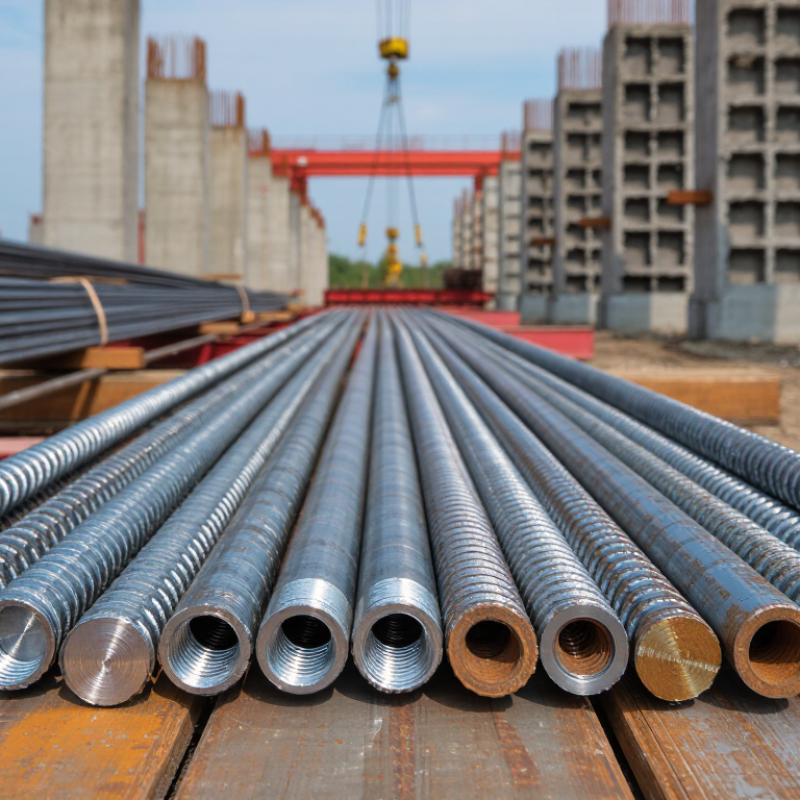
Thread steel bars are steel rods with continuous or intermittent threads along their length. They transfer tension, hold formwork, anchor rock, or connect reinforced concrete components. Their classification starts with thread geometry. Coarse threads tolerate dirt and field handling. Fine threads provide more adjustment but require cleaner installation. Bars are also grouped by steel grade, diameter, yield strength, and surface condition.
International standards make comparison easier.
ISO 6935-2 covers ribbed reinforcing steel and includes strength classes such as B400 and B500. ASTM A615 commonly identifies carbon-steel reinforcing bars by Grades 40, 60, 80, and 100. ASTM A955 addresses stainless reinforcing bars, which suit chloride-rich or highly corrosive environments. Buyers should check thread pitch, nominal area, tensile strength, elongation, and coupling compatibility. A matching diameter alone proves very little.
Surface treatment creates another category.
Plain bars are economical for protected interiors. Galvanized or epoxy-coated bars provide additional corrosion resistance, although damaged coating needs inspection. World Steel Association data recorded about 1.84 billion tonnes of crude steel production in 2024, showing the scale of the supply chain. Yet volume does not guarantee consistency. OECD steel market reviews continue to highlight excess capacity and uneven regional demand. The classification boundary is not perfectly tidy. Product certificates, heat numbers, and independent tensile tests remain essential before shipment.
Materials, Strength Grades, Threads, and Surface Treatments
2026 Top Thread Steel Bar Types for Global Buyers
Materials and strength grades should be checked before thread selection. The World Steel Association reported global crude steel production near 1.9 billion tonnes in 2023. This scale supports broad sourcing, but quality varies between mills and batches. Carbon steel bars suit general anchoring and structural connections. Alloy steel performs better under repeated loads and elevated temperatures.
ISO 898-1 identifies common fastener classes such as 8.8 and 10.9. Class 8.8 reaches approximately 800 MPa nominal tensile strength. Class 10.9 reaches approximately 1,000 MPa. ASTM A193 Grade B7 requires at least 860 MPa tensile strength and 725 MPa yield strength. These figures are useful, not universal. Buyers should request mill certificates, heat numbers, and test temperatures.
Thread geometry affects installation. M16 × 2 and M20 × 2.5 are common metric choices, while UNC and UNF serve different markets. Fine threads can improve adjustment, but they may clog more easily on dusty sites. Surface treatments also deserve careful review. Electro-zinc plating offers a thin, bright barrier. Hot-dip galvanizing provides thicker protection for outdoor exposure. ASTM A153 evaluates galvanized coating mass, not visual brightness. Black oxide suits indoor applications with controlled humidity. A shiny bar can still have poor thread fit. I would verify gauge measurements, coating thickness, and nut compatibility before approving shipment.
How Thread Steel Bars Are Manufactured and Quality Tested
In 2026, global buyers are comparing thread steel bars by more than nominal diameter. The manufacturing route affects strength, fit, and service life. Production usually starts with tested steel billets. Mills heat and roll them into straight bars under controlled temperatures. Threads may be formed by cold rolling, machining, or a combined process. Cold-formed threads preserve fiber continuity, while machining removes some surface material. The thread matters.
After forming, each bar receives visual and dimensional inspection. Technicians check diameter, pitch, thread profile, straightness, and end condition. Calibrated gauges should confirm nut engagement without excessive force. Tensile tests measure yield strength, ultimate strength, and elongation. Bend tests can reveal brittle behavior or surface cracking. Chemical analysis verifies carbon, alloying elements, and consistency between heats. Small errors spread.
Reliable suppliers link every bundle to a heat number, test report, and inspection record. Buyers should request sampling plans, gauge calibration dates, and actual test values. General certificates are not enough. Ultrasonic inspection may detect internal discontinuities in critical applications. Packaging also deserves attention; damaged threads can fail before installation. Field inspections often find clean-looking bars with poor pitch control. No test is perfect, and sampling can miss local defects. That weakness deserves honest review. Independent verification remains sensible for unfamiliar sources or demanding projects.
2026 Top Thread Steel Bar Types for Global Buyers
Thread steel bars are commonly supplied as solid continuous-thread bars for anchoring, rock reinforcement, soil nails and prestressing-related applications. The chart shows theoretical mass by nominal diameter, calculated with the widely used steel-bar formula: mass (kg/m) = diameter² ÷ 162.
Typical manufacturing includes steel billet heating, hot rolling, continuous thread forming, cutting and straightening. Quality verification normally includes dimensional and thread-gauge inspection, tensile and yield-strength testing, elongation testing, bend testing when specified, and visual or surface inspection. Actual acceptance limits depend on the applicable project specification and standard.
How Global Buyers Choose, Specify, and Source the Right Type
2026 Top Thread Steel Bar Types for Global Buyers
Global buyers choose threaded steel bars by application, not by diameter alone. Fully threaded bars support anchoring, tie systems, and adjustable connections. Coarse-thread bars tolerate dirt and field handling better. Fine-thread bars can offer precise adjustment, but they demand cleaner installation. Continuous-thread designs also simplify coupler placement and length changes.
Specification should state diameter, thread pitch, bar length, steel grade, yield strength, tensile strength, and surface condition. Include straightness limits and acceptable thread damage. For exposed projects, buyers may request galvanized or coated bars. However, coating thickness can affect thread fit. That detail is often missed. It should not be.
Reliable sourcing starts with documented traceability. Request heat numbers, mill certificates, dimensional reports, and independent test results. Check whether the supplier can produce consistent batches, not only attractive samples. Confirm the inspection method before production begins. A small thread-gauge check can reveal problems early. It is inexpensive protection.
Shipping conditions also influence the decision. Long bars need strong bundling, moisture control, and clear markings. Verify packaging photos before dispatch. Compare total delivered cost, including cutting, coatings, customs handling, and replacement risk. The lowest quotation may become expensive after installation delays. No type is perfect for every project. Even experienced buyers should review the specification when site conditions change.