China Top 10 Rough Terrain Pallet Truck Manufacturers
China’s material-handling sector is moving beyond smooth warehouse floors. Rough Terrain Pallet Truck demand is growing where farms, construction yards, ports, and rural distribution centers face gravel, mud, and uneven concrete. These conditions punish small wheels and weak frames. They also expose marketing claims quickly.
Grand View Research valued the global material handling equipment market at approximately US$216.5 billion in 2023. Its report projects continued growth through 2030, supported by logistics expansion, industrial investment, and warehouse modernization. The MHI 2024 Annual Industry Report also identifies labor shortages, resilience, and automation as major investment pressures. These trends create room for Chinese manufacturers with competitive pricing, export experience, and increasingly capable product engineering.
Performance still matters more than catalog language. A reliable Rough Terrain Pallet Truck should show stable steering, sufficient ground clearance, protected hydraulics, and dependable braking on slopes. Battery life matters too. A truck that stops beside a muddy loading bay creates more than inconvenience. It can delay an entire shipment.
John Paxton, former President and CEO of MHI, stated, “The future of supply chains is digital, connected, and increasingly autonomous.” That direction is important, but rough outdoor handling remains intensely physical. Sensors cannot repair a damaged fork. Software cannot replace disciplined maintenance. China’s top ten manufacturers must therefore balance smart features with rugged construction, verified load ratings, and accessible spare parts. Some product comparisons remain imperfect, because published test conditions differ widely. Buyers should question impressive specifications and request field evidence. This guide examines the leading Chinese manufacturers through product capability, manufacturing experience, certifications, service networks, and practical outdoor performance.
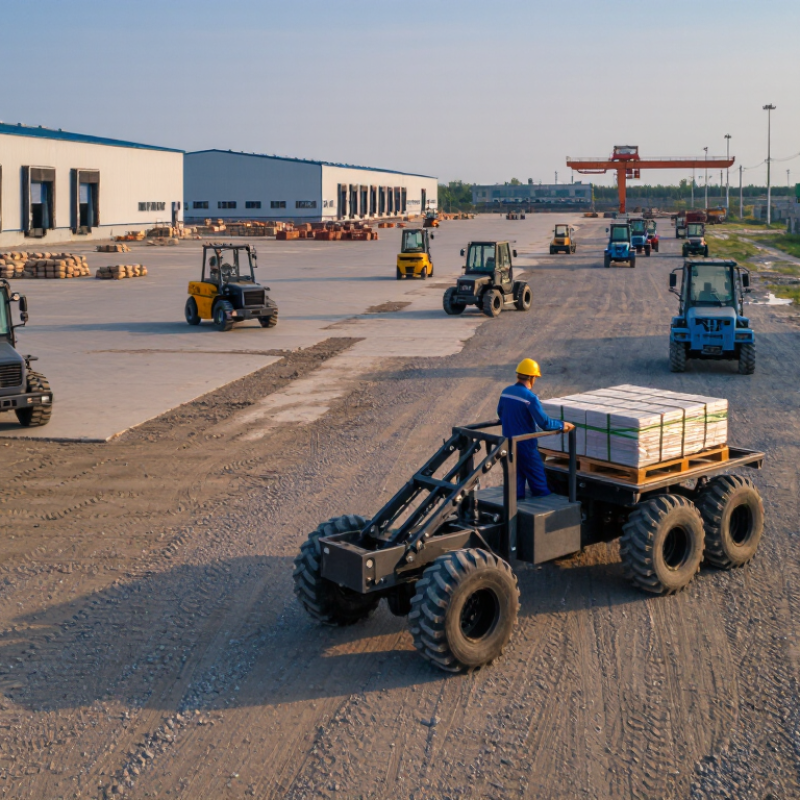
What Is a Rough Terrain Pallet Truck?
A rough terrain pallet truck is a material-handling vehicle designed to move palletized loads across uneven outdoor surfaces. Unlike a standard warehouse pallet truck, it uses larger pneumatic or semi-pneumatic tires. These tires help cross compacted soil, gravel, yard transitions, and damaged concrete.
The truck usually has reinforced forks, a stronger chassis, and improved ground clearance. Some models use a small engine, while others use battery power. Its job is controlled horizontal movement, not high-level lifting. No high lifting. The load remains close to the ground, which helps reduce tipping risk on irregular surfaces.
In practical use, operators may move building supplies, agricultural materials, or packaged goods between delivery vehicles and storage areas. Loose gravel can still reduce steering control. Wet grass may become surprisingly dangerous. A common mistake is treating the “rough terrain” label as unlimited capability. It is not. Check the rated capacity, tire condition, slope limits, braking system, and fork dimensions before operation. Keep the load balanced, centered, and below the stated limit. I would also inspect the travel path for potholes and hidden drainage channels. This small step is easy to overlook. Training matters. Even experienced workers can misjudge a slope when the pallet blocks their view. Specifications deserve careful comparison because ground clearance, turning radius, and actual outdoor performance can vary considerably between designs.
How China’s Top 10 Manufacturers Are Evaluated
Evaluating China’s top ten rough terrain pallet truck manufacturers requires more than comparing catalog prices. The review begins with real production experience, including engineering history, factory capacity, and completed outdoor handling projects. A credible supplier should explain how its trucks perform on gravel, mud, slopes, and uneven loading yards. Photos help, but test records matter more. Evaluators examine rated capacity, ground clearance, traction, braking distance, steering response, and frame durability. They also check whether performance changes under heat, dust, rain, and repeated loading cycles.
Technical expertise is judged through design evidence, not confident wording. Reviewers inspect power systems, battery protection, tire selection, hydraulic components, and operator visibility. They compare specifications with independent test results and applicable safety requirements. A useful assessment includes production traceability, incoming material checks, final inspections, and calibration records. Factory visits can reveal gaps hidden in brochures. However, a short visit cannot prove long-term reliability. That limitation deserves attention.
Authority comes from verifiable references, qualified technicians, transparent documentation, and responsive after-sales support. Evaluators ask for service response times, spare-parts availability, warranty boundaries, and training procedures. They also review customization control, because an unusual load or narrow site can expose weak assumptions. Cost remains relevant, but the lowest quotation may conceal downtime, maintenance labor, or difficult parts sourcing. No ranking is flawless. Supplier data may be incomplete, and customer feedback can reflect local conditions. A careful evaluation records these uncertainties instead of hiding them.
Profiles of China’s Top 10 Rough Terrain Pallet Truck Manufacturers
China’s top ten rough terrain pallet truck manufacturers show different strengths in design, production, and field support. Profile one focuses on compact trucks for narrow farm paths. Profile two develops reinforced frames for construction yards. Profile three emphasizes pneumatic tires and stable steering on loose gravel. Profile four supplies higher-capacity models for warehouses near ports. Profile five combines simple controls with durable hydraulic systems. Profile six targets agricultural users who need easy maintenance. Profile seven offers battery-assisted models for quieter indoor and outdoor work. Profile eight specializes in customized forks and lifting heights. Profile nine highlights corrosion-resistant components for humid regions. Profile ten provides practical models for small contractors and rural distributors.
These profiles should not be treated as a final ranking. Factory visits, sample testing, and service records can change the order. In my experience, a strong pallet truck is not defined by lifting capacity alone. It must keep balance on slopes, protect the operator’s view, and remain controllable after repeated impacts. Some published specifications also need closer checking. Real ground conditions are often harsher than showroom demonstrations.
Tips: Check tire size, rated load, turning radius, ground clearance, and brake performance. Ask for test reports and spare-parts availability. Compare actual maintenance access, not only purchase price. A short field trial is valuable. Mud exposes weaknesses quickly.
Product, Technology, and Performance Comparison
Comparing the top ten rough terrain pallet truck manufacturers requires more than checking lifting capacity. Their products differ in frame geometry, wheel layout, fork length, and control design. A field-ready truck should carry 1,000 to 2,500 kilograms across gravel, compact soil, and uneven concrete. Large pneumatic tires improve clearance, while puncture-resistant options reduce downtime near construction sites. Some models use reinforced forks and sealed bearings for dusty conditions. Others remain lighter and easier to load into a service vehicle. That trade-off matters.
Technology comparison begins with power systems. Hydraulic drive units offer strong low-speed control on slopes, but they may consume more energy. Electric traction systems reduce local noise and simplify indoor-outdoor operation. Battery monitoring, overload protection, and emergency braking should be tested, not accepted from a brochure. Ground-clearance sensors and adjustable handles can improve operator confidence. Yet electronic controls may struggle after water exposure or poor maintenance. Real performance depends on service access, spare-part availability, and technician training. These details often separate a promising design from dependable equipment.
In practical trials, measure travel speed with a full load, stopping distance, turning radius, and battery endurance. Repeat each test on wet gravel and a 10 percent incline. Short tests can mislead. One truck may climb well but sway when its load sits high. Another may feel stable yet lose productivity through slow lifting. Noise, vibration, tire wear, and fork alignment deserve written records. No manufacturer gets every decision right. Buyers should compare warranty terms, inspection intervals, and documented test data before choosing a machine for daily work.
How to Choose the Right Chinese Manufacturer for Your Needs
Choosing a Chinese rough terrain pallet truck manufacturer requires more than comparing prices. The 2023 World Bank Logistics Performance Index ranked China 19th globally, with a score of 3.7. This supports strong export capability, but logistics performance does not prove product quality. Request factory audit records, load-test videos, weld inspection results, and traceable component lists.
Match the truck to your site. Measure pallet weight, uneven ground, ramp gradients, aisle width, and daily operating hours. Check rated capacity at the required load center, ground clearance, tire construction, braking distance, and gradeability. Ask whether testing follows ISO 3691-5 safety requirements for rough-terrain industrial trucks. Battery models need charging data, while engine models need fuel consumption and service intervals.
Look beyond the quotation.
The 2024 MHI Annual Industry Report found that 55% of surveyed supply-chain professionals planned to increase technology investment. That figure suggests buyers should evaluate service systems, not only hardware. Confirm spare-parts availability, remote diagnostics, operator training, warranty exclusions, and response times in writing. I have seen low prices hide expensive downtime. I also once underestimated local terrain data; that mistake weakened the equipment specification. A capable manufacturer should challenge your assumptions, provide a sample inspection plan, and explain where its design may not fit. Trade references and independent pre-shipment inspection add useful reliability.
China Top 10 Rough Terrain Pallet Truck Manufacturers: Buyer Priority Framework
The chart presents a practical 100-point purchasing framework for evaluating Chinese rough terrain pallet truck manufacturers. Product safety and after-sales service receive the highest weighting because outdoor material-handling equipment must provide reliable operation, accessible spare parts, and responsive technical support. Capacity, terrain performance, parts availability, and compliance should also be checked against the buyer’s operating conditions and local regulations.