What is a strong base anion resin and how does it work?
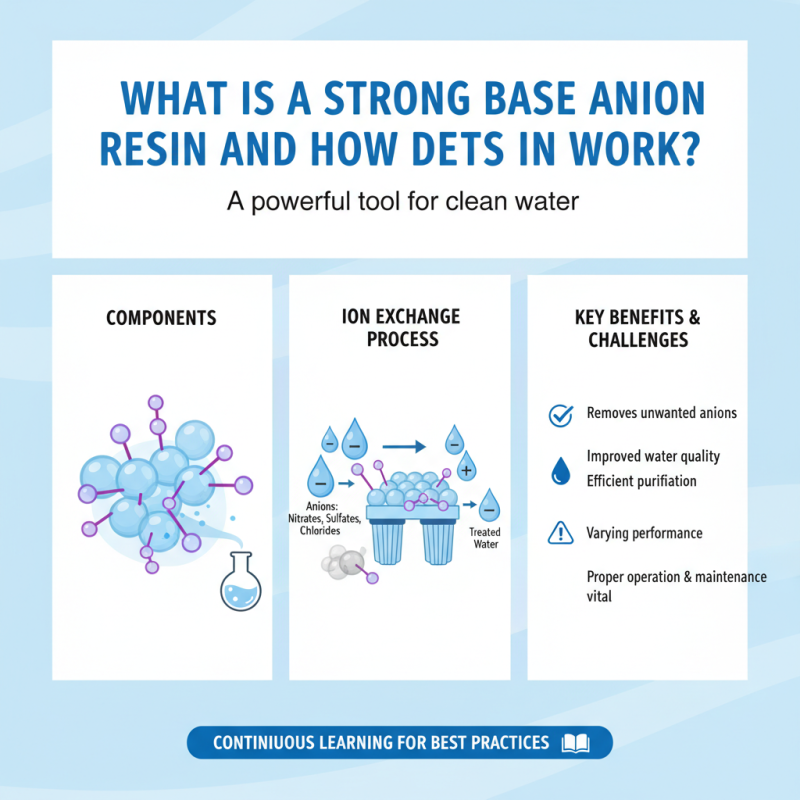
strong base anion resin plays a crucial role in water treatment and purification. This specialized material effectively removes unwanted anions from water, improving its quality. It consists of polymer beads and functional groups that attract and bind various pollutants.
When water flows through a strong base anion resin, charged ions are exchanged through a process called ion exchange. This allows the resin to capture contaminants like nitrates, sulfates, and chlorides. Users often find the resin efficient, but some challenges arise. For instance, not all resins perform equally under varying conditions.
Understanding the specific applications of strong base anion resins can enhance their effectiveness. Proper operation and maintenance are vital for optimal performance. Some users may overlook this, leading to inefficient results. Overall, strong base anion resin remains a powerful tool for achieving clean water, but continuous learning is essential for best practices.
Definition of Strong Base Anion Resins
Strong base anion resins are vital in water treatment and purification processes. They are a type of ion exchange resin that effectively removes negatively charged ions from solutions. These resins are primarily made of a cross-linked polystyrene backbone, which provides the structure necessary for their function.
These resins contain positively charged sites that attract and bind anions like sulfates and nitrates. When water passes through these resins, unwanted anions are exchanged for hydroxide ions. This ion exchange leads to highly purified water, essential in various industries. Reports suggest that strong base anion resins can achieve removal efficiencies exceeding 90% for certain contaminants.
Tips: Ensure proper resin regeneration to maintain performance. Regular checks on anion concentrations in treated water are crucial.
Performance can vary based on conditions. The resin's effectiveness depends on pH levels and temperature. Suboptimal conditions may lead to reduced ion exchange rates. Continuous monitoring is key to maximizing efficiency. This highlights the ongoing need for research in optimizing resin use for specific applications. Understanding how these resins work helps in making informed choices for water treatment solutions.
Composition and Structure of Strong Base Anion Resins
Strong base anion resins are vital in water treatment processes. Their composition typically includes a polymer matrix that allows for efficient ion exchange. These resins are composed of quaternary ammonium functional groups. They interact with negatively charged ions in water. This interaction results in the removal of unwanted anions.
The structure of strong base anion resins contributes to their effectiveness. The high cross-linking density enhances stability. This stability is critical in varying pH and temperature conditions. According to industry reports, these resins can effectively reduce contaminants like nitrates and sulfates by up to 90%. However, this capacity may diminish over time due to saturation.
Tips: Regular monitoring of resin performance is essential. Consider regeneration cycles based on usage. This can prolong the lifespan of the resin and maintain its efficiency. Note that not every resin will perform equally in all conditions. Understanding the specific application helps in making better decisions. Always consult analytical data before selecting a resin for a specific task.
What is a strong base anion resin and how does it work? - Composition and Structure of Strong Base Anion Resins
| Property | Description | Applications | Typical Ionic Form |
| Composition | Cross-linked polymer matrix containing quaternary ammonium functional groups. | Water treatment, wastewater treatment, hydrometallurgy. | Cl-, OH- |
| Structure | Spherical beads with a uniform size, allowing for high surface area and efficient ion exchange. | Desalination, water softening. | Br-, I- |
| Ion Exchange Capacity | Typically ranges from 1.0 to 1.5 meq/mL. | Industrial water purification, pharmaceuticals. | NO3-, SO42- |
| Regeneration | Can be regenerated with strong alkaline solutions like sodium hydroxide. | Water demineralization, laboratory applications. | OH-, CO32- |
Mechanism of Action in Ion Exchange Processes
Strong base anion resins play a pivotal role in ion exchange processes. These resins are composed of polymer networks that contain quaternary ammonium functional groups. They are specifically designed to attract and exchange anions in water treatment applications. When water passes through these resins, undesirable anions are captured and replaced by hydroxide ions. This exchange purifies the water, removing contaminants.
The mechanism of action is fascinating yet complex. As water flows through a bed of strong base anion resin, ions of interest come into contact with the resin's surface. Anions in the water form ionic bonds with the positively charged sites on the resin. This interaction leads to a release of hydroxide ions. It’s crucial to note that while this process is effective, some factors can limit its efficiency. Resin saturation and fouling can occur, hindering performance. Regular regeneration and maintenance are needed, which adds to operational costs.
In practical applications, the effectiveness of strong base anion resins can vary. This variance depends on factors like water chemistry and flow rates. Monitoring these variables is essential for optimal performance. Sometimes, unexpected challenges arise. For instance, certain ions may compete for exchange sites, leading to incomplete removal. A continual evaluation of system performance can help in refining the process. Emphasizing these nuances ensures a more effective use of ion exchange technologies.
Ion Exchange Capacity of Strong Base Anion Resins
This chart illustrates the ion exchange capacity of different types of strong base anion resins measured in milliequivalents per milliliter (meq/mL). The values indicate how efficiently these resins can exchange ions in water treatment processes.
Applications of Strong Base Anion Resins in Water Treatment
Strong base anion resins play a crucial role in water treatment. These resins are designed to remove negatively charged ions from water. They effectively tackle contaminants such as nitrates, sulfates, and organic matter. In 2021, the global market for water treatment was valued at approximately $600 billion, with an increasing demand for efficient filtration systems.
In municipal and industrial water treatment, strong base anion resins are often used in combination with cation resins. This combined approach helps achieve high purity levels in water. Studies reveal that using these resins can enhance water quality by over 90%. This is important for both human health and environmental sustainability. However, not all systems perform equally. Some resins may require frequent regeneration, leading to operational challenges.
Additionally, the effectiveness of strong base anion resins can decline over time. Factors such as flow rates and water chemistry affect their performance. The need for ongoing maintenance and monitoring poses questions about efficiency. As water quality standards become more stringent, these issues require serious attention. Exploring innovative solutions may help address these challenges. Continuous improvement in resin technology could lead to better results in water treatment.
Comparison with Weak Base Anion Resins
When comparing strong base anion resins to weak base anion resins, differences become clear. Strong base anion resins have a higher capacity for ion exchange. They effectively remove a broader range of anions from solutions. Chlorides and nitrates are no match for them. They work well in various pH conditions, which is a significant advantage.
On the other hand, weak base anion resins operate differently. They manage to exchange anions at lower pH levels. This can lead to practical scenarios where they excel when strong base resins may struggle. Weak resins, however, are less effective in heavily contaminated environments. Their efficiency decreases when exposed to high concentrations of competing anions.
While strong base resins seem superior, they also have limitations. They can be more costly and complex to regenerate. This means careful planning is essential. Proper evaluation of the application is critical. Both types have their merits. Understanding the specific needs can make all the difference.