What Is Pharmaceutical Gelatin Used For?
Pharmaceutical Gelatin is a purified protein used in medicines where its ability to form films, gels, or dissolving shells is useful. Its most familiar role is in hard and soft capsules: a smooth shell can enclose powder, granules, or liquid, making a dose easier to swallow and helping protect its contents. It also appears in selected tablet coatings and medical products. The exact use depends on the formulation. Not every gelatin is interchangeable.
The market context is substantial, though it needs careful interpretation. Grand View Research estimated the global gelatin market at approximately USD 3.9 billion in 2023 and projected continued growth through 2030 in its Gelatin Market Size, Share & Trends Analysis Report. That figure covers gelatin across multiple sectors; it is not a pharmaceutical-only estimate. Still, it reflects broad demand for a material valued for its functional properties. In medicine, those properties must meet tighter expectations for consistency, purity, and performance. Small differences matter.
This guide explains what pharmaceutical gelatin does, where manufacturers use it, and why material specifications affect the finished product. It also considers practical limits, including its animal-derived origins and sensitivity to heat and moisture. These details can be easy to overlook. A capsule shell may look simple, but its performance depends on careful sourcing, testing, and formulation.
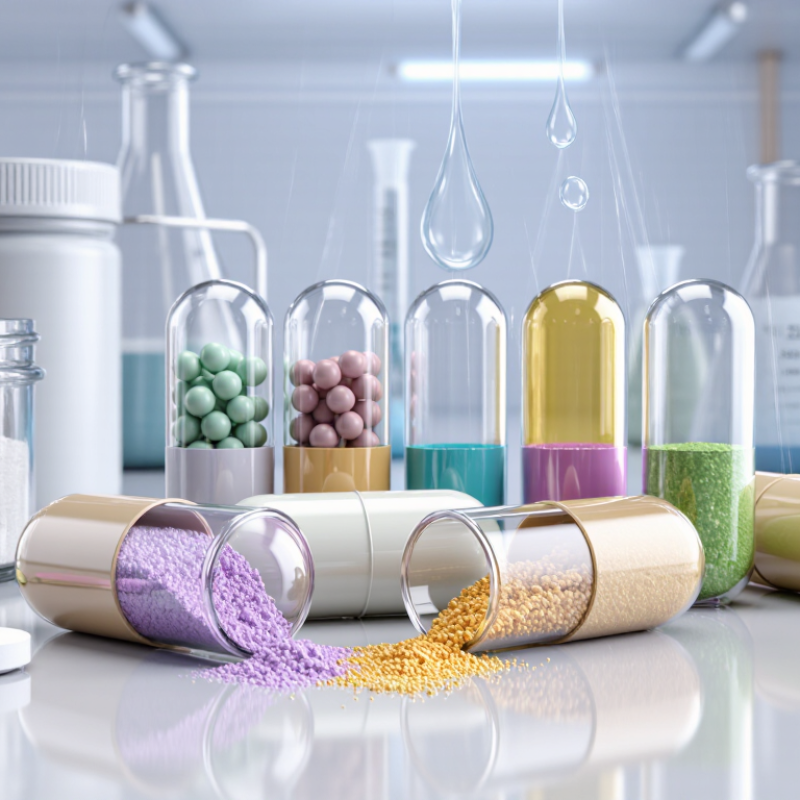
Pharmaceutical Gelatin: Animal Sources, Composition, and 50–300 Bloom Grades
What Is Pharmaceutical Gelatin Used For?
Pharmaceutical gelatin is used in hard and soft capsules, tablet coatings, and some formulations that need a binding or gelling agent. It is made by processing collagen, usually from bovine or porcine tissues; fish sources are also used in some products. Its main protein components contain amino acids such as glycine, proline, and hydroxyproline. The source and manufacturing process can affect its properties. Details matter.
Bloom strength describes how firm a gelatin gel becomes under standardized test conditions. Pharmaceutical grades may range from about 50 to 300 Bloom. Lower-Bloom gelatin generally forms a softer gel, while higher-Bloom grades tend to form a firmer one. Bloom is not a simple quality score. Formulators also consider viscosity, setting behavior, purity, and compatibility with other ingredients. A number alone does not tell the whole story.
Tips: Check the specified animal source, Bloom range, and applicable quality documentation for the intended use. If a capsule shell feels brittle or sets too slowly, the grade or processing conditions may need review. Small differences can matter, and results should be confirmed through appropriate testing.
Hard Capsules: Gelatin Shells Across Standard Sizes 000–5
Hard gelatin capsules provide a preformed shell for powders, granules, and some pellets. Their familiar size numbers run from 000, the largest, to 5, the smallest. Industry capsule-sizing tables commonly report nominal shell volumes of about 1.37 mL for size 000, 0.95 mL for 00, and 0.68 mL for 0. Smaller sizes include 0.50 mL for size 1, 0.37 mL for 2, 0.30 mL for 3, 0.21 mL for 4, and 0.13 mL for 5. These are volume estimates, not guaranteed fill weights. Powder density changes the amount each shell can hold.
That distinction is easy to overlook. A fluffy powder may need a larger shell than a dense blend, even when both contain the same mass. Technical sizing charts are useful for early selection, but pilot filling checks are more dependable. Shell fit also affects handling: a capsule that is too large may be difficult to swallow, while a tightly filled shell may not close consistently. Small details matter. For finished dosage forms, USP–NF General Chapter <701> describes disintegration testing; it does not set capsule fill volumes. So, size selection and product performance need separate checks. The published figures are helpful, but real formulations can be less tidy than a table suggests.
What Is Pharmaceutical Gelatin Used For? — Hard Capsules: Gelatin Shells Across Standard Sizes 000–5
Pharmaceutical gelatin is commonly used to make hard capsule shells that enclose powders or granules. The chart compares approximate internal volumes for standard capsule sizes: smaller size numbers indicate larger capsules. Actual fill weight depends on the formulation’s density and flow properties, and capacity may vary slightly by capsule design.
Softgels: How Gelatin Forms a Sealed Shell Around Liquid Medicines
A softgel is a one-piece capsule with a liquid or semi-solid medicine inside. During production, warm gelatin forms two ribbons; a rotary die presses them together around a measured fill. The joined edge creates a sealed shell that helps prevent leakage and keeps each dose contained.
A small seal matters.
The shell also makes some oils and poorly water-soluble ingredients easier to package as a swallowable dose.
Gelatin quality affects how the shell forms. The Gelatin Manufacturers Institute of America’s Gelatin Handbook describes the Bloom test: a 6.67% gelatin gel is conditioned at 10°C for 17 hours before its firmness is measured. This gives manufacturers a repeatable strength measure, but it does not prove how quickly a finished softgel releases its contents.
The United States Pharmacopeia’s General Chapter <701> describes disintegration testing; the applicable monograph sets the product’s acceptance criteria.
Shell thickness, moisture, fill composition, and storage can all affect performance. A higher Bloom value alone is not proof of better medicine delivery.
Gelatin is useful, but not a universal barrier: heat and humidity can change shell behavior, so packaging and storage matter.
Other Uses: Gelatin in Tablets, Microencapsulation, and Hemostatic Sponges
Pharmaceutical gelatin has useful work to do beyond capsule shells. In tablets, it can bind powdered ingredients, helping a pressed tablet hold its shape during handling. The amount matters: too little may weaken the tablet, while too much can affect how quickly it breaks apart. USP–NF’s excipient standards underscore why material properties and formulation performance need careful control.
Gelatin also forms protective microcapsules around sensitive ingredients. In complex coacervation, gelatin combines with another polymer to create a coating that can help regulate release; Gouin’s review of microencapsulation technologies describes this method’s established industrial role (2004). Small particles, different behavior. In surgery, porous gelatin sponges help control bleeding by providing a surface for clot formation. Achneck et al.’s review reports that absorbable gelatin sponge can take up roughly 40–50 times its weight in fluid (Annals of Surgery, 2010). That figure is not a promise for every product or wound: pore structure and placement matter, and clinical judgment still matters more than a headline number.
What Is Pharmaceutical Gelatin Used For? — Other Uses: Gelatin in Tablets, Microencapsulation, and Hemostatic Sponges | Application | How Gelatin Is Used | Main Function | Typical Product Form | Key Considerations |
| Tablets | Used as a binder in some tablet formulations, helping powder particles adhere during granulation and tablet compression. | Supports tablet formation and can contribute to mechanical strength. | Gelatin incorporated into a tablet formulation, often as part of a binder solution. | Performance depends on the formulation and manufacturing process. Gelatin is not required in all tablets; other binders may be selected to suit the active ingredient and desired tablet properties. |
| Microencapsulation | Can form a coating or matrix around small droplets or particles. In coacervation processes, gelatin may be combined with another polymer, such as gum arabic. | Helps separate an ingredient from its surroundings and can modify its release or protect it during processing and storage. | Microscopic capsules or coated particles containing an active ingredient. | Release behavior depends on the shell composition, capsule size, processing conditions, and any crosslinking. Formulations require testing for stability and the intended release profile. |
| Hemostatic sponges | Processed gelatin is formed into a porous, absorbable sponge that can be applied to a bleeding site during surgery. | Provides a physical matrix that absorbs blood and supports local clot formation. | Sterile, porous gelatin sponge for topical surgical use. | Used according to the product’s instructions and clinical judgment. It is intended for local application; use, placement, and removal or absorption depend on the specific clinical situation and product labeling. |
| Capsule shells | Forms the shell material of many hard and soft capsules. | Encloses a medicine dose and provides a convenient dosage form. | Hard capsule shells or soft gelatin capsules. | Moisture content, storage conditions, and compatibility with the fill material can affect shell properties and product stability. |
Quality Testing: Bloom Strength Measured with a 6.67% Gel at 10°C
Pharmaceutical gelatin is used in hard and soft capsules, tablet coatings, and some binding applications. Its gel strength matters because it affects shell firmness, handling, and manufacturing consistency. A capsule shell that feels sturdy on the bench may still behave differently after storage or exposure to moisture. That gap deserves attention.
Bloom strength is measured under defined conditions, not by judging a gel by touch. The Gelatin Manufacturers Institute of America’s Methods and Tests for Gelatin specifies a 6.67% gel, conditioned at 10°C for 16–18 hours. A standardized plunger then penetrates the gel, and the required force is reported in grams as the Bloom value. For a 112.5-gram test mixture, 6.67% gelatin represents about 7.5 grams. Small details matter. Uneven heating or cooling can shift results, so sample preparation and temperature control must be consistent.
A higher Bloom value generally indicates a firmer gel, which can help formulators select gelatin for a target capsule or coating texture. But Bloom is not a complete performance score. It does not, by itself, predict dissolution, moisture response, or behavior on a production line. Pharmaceutical teams should interpret it alongside applicable pharmacopeial specifications and other material tests. The method is useful, though a single number can invite too much confidence.




