



How to Choose a Portable Water Air Cooler?

Choosing a Portable Water Air Cooler requires more than comparing tank sizes and advertised airflow. The U.S. Department of Energy explains that evaporative coolers can use about one-quarter of the electricity used by central air conditioning in dry climates. That figure matters, but only under suitable humidity conditions. In damp rooms, cooling may feel weak.

Industry research from Grand View Research and MarketsandMarkets shows continuing interest in evaporative cooling equipment, driven by lower energy consumption and rising summer temperatures. However, market reports often combine residential, commercial, and industrial products. Their figures should not be treated as exact evidence for every Portable Water Air Cooler.

ASHRAE Fellow William P. Bahnfleth has emphasized a key limitation of evaporative cooling: “Evaporative cooling adds moisture to the air while removing sensible heat.” This principle should guide your decision. Check the cooler’s airflow rating, noise level, water capacity, filter design, and automatic shutoff. A small bedroom may need quiet operation more than a large tank. A workshop may need stronger airflow and easier cleaning.

Look for clear testing information.

A low price can hide frequent maintenance. Mineral deposits may collect around the pump, tray, and cooling pad, especially when hard water is used. The best model depends on climate, room size, ventilation, and cleaning habits. Product tables cannot show everything. I may favor energy efficiency too strongly; real comfort also depends on humidity and personal tolerance. Use the specifications as evidence, not as a promise.
How to Choose a Portable Water Air Cooler?

Define Portable Water Air Coolers and Their Evaporative-Cooling Principles

A portable water air cooler is a compact fan that passes warm air through wet cooling pads. Unlike an air conditioner, it does not use refrigerant or seal a room. Its cooling effect comes from evaporation. When water changes into vapor, it absorbs heat from passing air. The fan then pushes this cooler, slightly humid air into the space.

This works best in dry climates, where air can accept more moisture. In a humid room, the effect may feel weak. It is not magic.

When choosing one, check the water-tank size, airflow direction, noise level, and cleaning access. A larger tank may support longer use, but it can add weight. Adjustable fan speeds help when temperatures change during the day. My practical check is simple: stand one meter away and feel the airflow before buying. I once focused too much on tank capacity and overlooked awkward refilling. That mistake changed my priorities.

Tips: Use clean water and empty the tank after use. Clean the pads regularly to reduce odors and mineral buildup. Keep a window or door slightly open, especially in humid conditions. Place the cooler near you, not across a large room. Avoid expecting it to cool an entire house. A low energy label is useful, but real performance also depends on room size, humidity, and airflow.

Match Cooling Performance to Room Size Using 500–3,000 CFM Airflow Ratings

How to Choose a Portable Water Air Cooler?

Match Cooling Performance to Room Size Using 500–3,000 CFM Airflow Ratings

A portable water air cooler should match the room, not just its tank size. Airflow is usually measured in CFM, or cubic feet per minute. A 500–1,000 CFM unit may suit a small bedroom, home office, or reading area. Medium rooms often need about 1,000–2,000 CFM. Large open spaces may require 2,000–3,000 CFM, especially with high ceilings or frequent air movement.

Measure the room before choosing. Multiply its length, width, and height to estimate cubic volume. A 12-by-15-foot room with an 8-foot ceiling contains 1,440 cubic feet. A 1,000 CFM cooler could theoretically move that air in about 1.4 minutes. Real performance is slower because furniture, open doors, and heat sources interfere. That calculation helps, but it is not a guarantee.

I have found that airflow ratings can look impressive on paper. Placement matters more than expected. Keep the cooler near an open window or doorway, and leave space around the intake. Evaporative cooling works best in dry, ventilated conditions. In humid weather, adding water may provide limited comfort. Check noise levels, water capacity, caster strength, and cleaning access before buying. A smaller cooler may feel better if it is positioned correctly. My own room-size estimates have been imperfect, particularly in spaces with direct afternoon sunlight.

Check Humidity Suitability: Best Results Usually Occur Below 60% RH

How to Choose a Portable Water Air Cooler?

Check Humidity Suitability: Best Results Usually Occur Below 60% RH

A portable water air cooler works by evaporating water into moving air. This process can lower perceived temperature without a compressor. However, evaporation slows as humidity rises. In rooms above 60% relative humidity, airflow may feel damp rather than refreshing. A simple hygrometer gives a more honest reading than guesswork. Place it near the seating area, away from windows and vents.

For dry climates, look for adjustable fan speeds, a stable water tank, and directional louvers. A low-water alert prevents the pump from running unnecessarily. Wash the tank regularly, because standing water can develop odors and surface buildup. Keep doors or windows slightly open when practical. Fresh air helps moisture leave the room. Do not expect strong cooling in a sealed, humid bedroom. That is a common mismatch.

I once judged a cooler by its cold airflow alone. The room felt better for ten minutes, then became sticky. My mistake was ignoring humidity and measuring only temperature. Choose a model with clear airflow specifications and accessible filters. Check the manual for cleaning intervals and electrical safety guidance. Place the unit on a level, dry surface, away from fabrics and splash zones. In coastal or rainy areas, test it during the dampest part of the day.

Compare Water-Tank Capacity, Runtime, and Typical 50–250 W Power Draw

How to Choose a Portable Water Air Cooler?

A portable water air cooler should match your room, schedule, and available power. Tank capacity affects how often you refill it. A 5-liter tank may last several hours, while a 20-liter tank can support overnight use. Actual runtime varies with fan speed, humidity, and cooling-pad condition. In dry air, evaporation usually works better. In a damp room, cooling may feel limited.

Power draw commonly ranges from 50 to 250 watts. A lower setting saves electricity but may move less air. Higher settings cool more aggressively and empty the tank faster. Check the rated wattage, then measure real consumption with a plug-in watt meter. My first runtime estimate was too optimistic. I ignored the extra water used during continuous high-speed operation.

Tips: Compare tank size with your daily routine. If you dislike frequent refills, choose a larger tank. For desk use, avoid paying for oversized capacity. Calculate estimated runtime by dividing usable water volume by hourly consumption, but treat the result as approximate. Leave some space around the intake and exhaust vents. Clean the tank and cooling pad regularly. Dust can reduce airflow and create unpleasant odors. A 100-watt unit running for eight hours uses about 0.8 kilowatt-hours. That figure helps compare comfort with operating cost. However, household electricity rates differ, so check your local tariff.

How to Choose a Portable Water Air Cooler? - Compare Water-Tank Capacity, Runtime, and Typical 50–250 W Power Draw

Portable Cooler Class Typical Water-Tank Capacity Typical Power Draw Estimated Runtime per Full Tank Estimated Energy Use in 8 Hours Best Use Selection Notes
Compact Desk or Personal Unit 0.5–2 L 50–80 W Approximately 3–8 hours 0.40–0.64 kWh Personal cooling at a desk, bedside, or small workspace Easy to carry and refill; the cooling effect is usually limited to nearby occupants.
Small Portable Unit 3–6 L 80–120 W Approximately 4–12 hours 0.64–0.96 kWh Bedrooms, home offices, and small personal areas A practical balance between portability, airflow, tank size, and operating time.
Medium Portable Unit 7–12 L 120–180 W Approximately 6–16 hours 0.96–1.44 kWh Larger bedrooms, living areas, workshops, and covered outdoor spaces Longer runtime reduces refills, but the larger tank increases overall size and weight.
Large Portable Unit 13–20 L 180–250 W Approximately 8–20 hours 1.44–2.00 kWh Open-plan rooms, garages, patios, and semi-outdoor work areas Provides higher airflow and fewer refills, but requires more floor space and is less convenient to move.
How to interpret the figures: Runtime estimates assume a full tank and continuous operation in evaporative-cooling mode. Actual runtime varies with fan speed, pump operation, ambient temperature, humidity, airflow, and the unit’s water-consumption rate. Energy-use estimates are calculated as power draw multiplied by 8 hours; they exclude standby consumption.

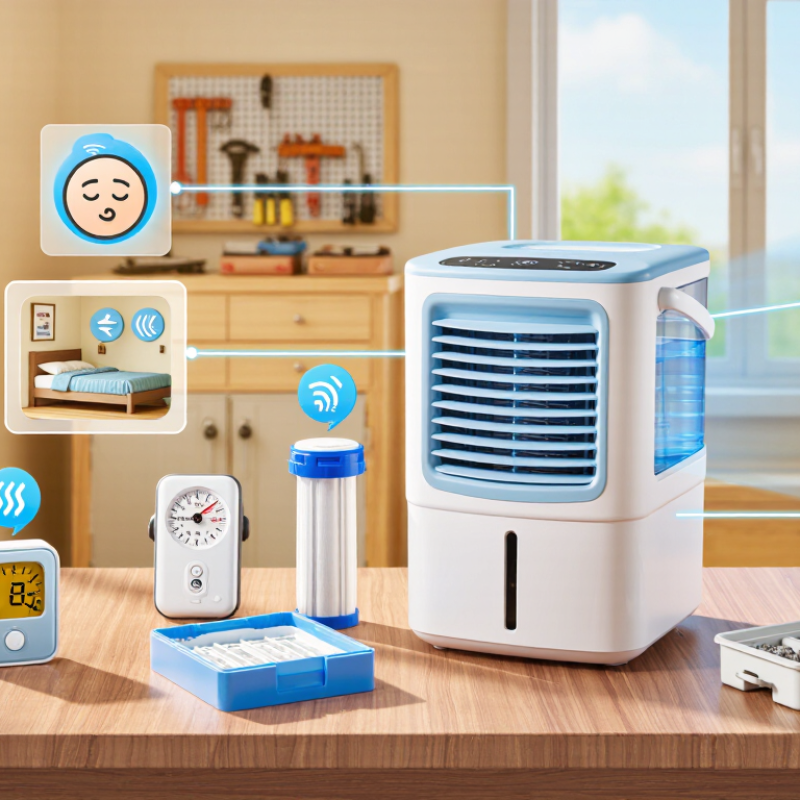
Evaluate Noise, Filters, Controls, Portability, and Safety Certifications

How to Choose a Portable Water Air Cooler?

Noise can decide whether a cooler feels useful or irritating. Check its stated decibel level, but remember that measurements vary by distance and fan speed. In a quiet bedroom, even a low hum may disturb sleep. I recommend testing the unit beside your chair before buying, if possible. Measure it yourself. Also inspect the water tank and filter. A removable tank is easier to rinse, while a washable dust filter can reduce routine replacement costs. However, evaporative coolers do not remove every pollutant, and their performance drops in very humid rooms.

Controls should be clear enough to use without reading instructions repeatedly. Look for separate settings for fan speed, cooling, timer operation, and oscillation. A remote control helps, but physical buttons remain useful when batteries fail. Small wheels matter. Check the handle, cord length, tank weight, and whether the unit fits under a desk or in a car. I once overlooked the tank weight; carrying it upstairs was less convenient than expected.

Safety deserves careful attention. Choose a model with stable feet, protected wiring, automatic shutoff for low water, and an accessible cleaning design. Check the certification label and verify that it comes from a recognized testing organization in your region. Do not rely on vague claims such as “fully certified.” Keep electrical connections away from spills, and follow the maintenance schedule. My own preference changed after noticing how quickly neglected water trays developed an odor. Convenience is helpful, but cleanliness needs daily judgment.

Whether your solution requires a single pumping application or an expansive engineered system,
CheckPoint is committed to becoming your partner in excellence.