



When a supplier quotes an industrial gummy making machine at “300 kg/h,” what does that actually mean? Is it the theoretical maximum of the depositor, or the real output at the end of a shift? Most buyers confuse the two.

This guide explains how to calculate real capacity, convert pieces to kilograms, and find the bottleneck that limits your actual throughput.
Capacity starts at the depositor: Cavities × Cycles per Minute × Piece Weight.
To convert to kg/h:
For example, with a 60-cavity mold, 40 cycles/min, and a 2.5g piece (illustrative):
If the machine is a YGDQ300 (rated 300 kg/h), this math shows how mold cavities and piece weight dictate actual output. The rating is a reference, not a guarantee.
A machine rated at 300 kg/h will not produce 300 kg every hour. Real output drops due to startup, cleaning, mold changes, and minor stops. Apply a realistic efficiency factor of 80–90%. For a 300 kg/h gummy bear production line, plan for 240–270 kg/h of good product.
The depositor is rarely the bottleneck—the slowest station is.
Machine: YGDQ450 (rated 450 kg/h)
Assumptions: 90 cavities, 45 cycles/min, 2.5g piece, 85% efficiency, 8-hour shift.
1. Theoretical: 90 × 45 = 4,050 pieces/min = 607.5 kg/h. (This exceeds the rating—normal, as mechanical limits will cap it at 450 kg/h.)
2. Adjusted: 450 kg/h (rated) × 0.85 = 382.5 kg/h
3. Shift Output: 382.5 × 8 = 3,060 kg per shift
This is the number to use for production planning—not the spec sheet.
When requesting a quote, confirm your factory can supply the required utilities:
| Model | Capacity | Speed | Steam | Compressed Air | Power | Length |
|---|---|---|---|---|---|---|
| YGDQ150 | 150 kg/hr | 35–55 n/min | 300 kg/h, 0.5–0.8 MPa | 0.2 m³/min | 18 kW | 14 m |
| YGDQ300 | 300 kg/hr | 35–55 n/min | 400 kg/h, 0.5–0.8 MPa | 0.25 m³/min | 27 kW | 14 m |
| YGDQ450 | 450 kg/hr | 35–55 n/min | 500 kg/h, 0.5–0.8 MPa | 0.3 m³/min | 34 kW | 17 m |
| YGDQ600 | 600 kg/hr | 35–55 n/min | — | — | 38 kW | 17 m |
Note: All models require 20–25°C and 55% humidity. YGDQ600 steam/air specs not listed.
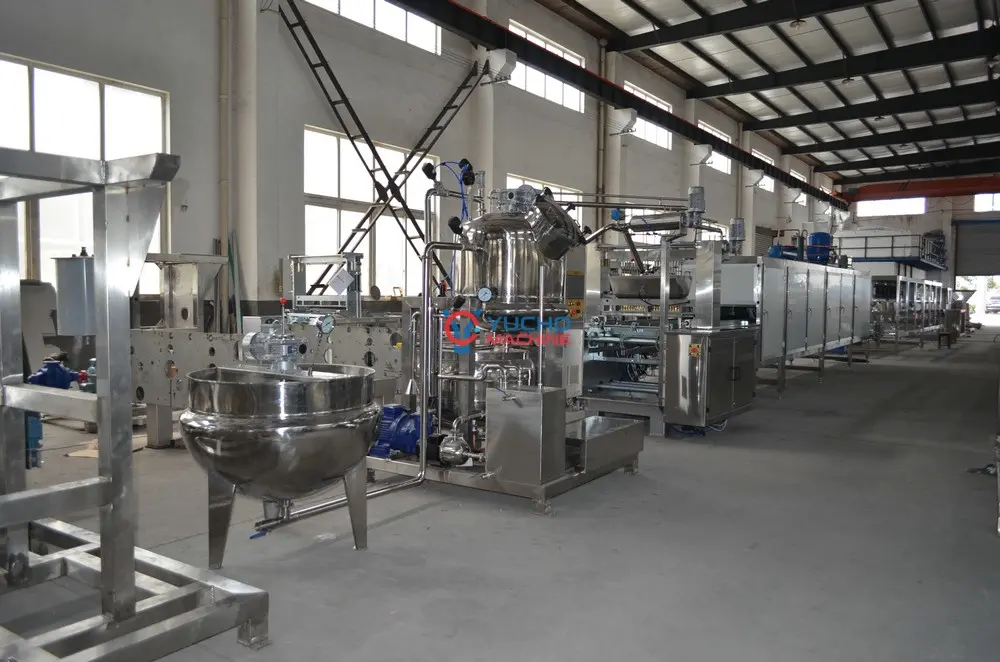
Capacity is not a single number on a spec sheet. It is the result of cavity count, cycle speed, piece weight, and your factory's utilities.
If you are evaluating a Gummy Production Line and want a realistic throughput estimate, send us your piece weight, mold cavities, and shift targets. We will calculate the actual capacity and identify the bottleneck before you buy.
Shanghai Yucho Industrial Co., Ltd. supplies complete Gummy Production Lines, from the YGDQ50-80 tabletop depositor to the YGDQ600 high-capacity line. Our engineers can calculate real capacity based on your recipe, piece weight, and production schedule—and identify the bottleneck before you invest.

Whether your solution requires a single pumping application or an expansive engineered system,
CheckPoint is committed to becoming your partner in excellence.