



10 Digital Crimper Buying Tips for Global Buyers
Choosing a Digital Crimper for international production is not simply a matter of comparing prices. The right tool must match terminal design, wire range, production volume, and local power conditions. A crimper that performs well on a factory bench may struggle in a dusty workshop or during long export shipments. This guide examines ten practical buying factors, including crimp accuracy, display readability, battery life, calibration, jaw compatibility, safety features, and after-sales support.
Market signals make this decision more important. The International Energy Agency reported that global electric car sales reached nearly 14 million units in 2023, increasing demand for reliable wiring, terminals, and connection systems. IPC’s electronics industry reports also continue to identify supply-chain pressure, labor shortages, and quality consistency as major manufacturing concerns. These trends affect even small cable-assembly operations. A dependable Digital Crimper can reduce repetitive errors, record process data, and help operators maintain consistent compression across batches. But digital features are not automatically useful.
Look closely.
Some buyers focus on screen size and ignore calibration records. That is a mistake. Others choose the cheapest model, then discover that replacement dies are unavailable in their region. I have seen purchasing teams overlook connector standards, warranty response times, and training requirements. Those details become expensive later. The following ten tips offer a more disciplined way to compare suppliers, verify performance, and select equipment that remains practical across different markets. Claims should be tested against samples, technical documents, and independent inspection whenever possible.
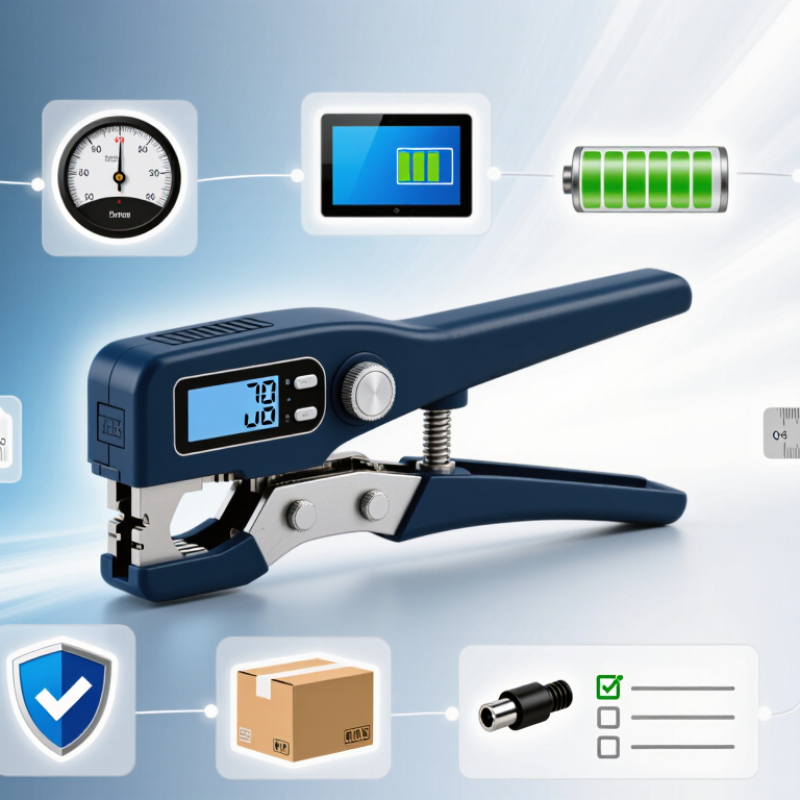
Define Digital Crimper Types, Uses, and Essential Features
Digital crimpers are not one universal tool. Handheld battery models suit field repairs and small cable batches. Benchtop electric units provide better repeatability for production lines. Hydraulic digital crimpers handle larger terminals and thicker conductors. Your application decides the correct type.
These tools serve electrical cabinets, vehicle harnesses, renewable energy systems, and industrial equipment. A digital display can show crimp force, cycle count, or pressure. Useful data. However, a bright screen does not prove accuracy. Look for compatible dies, adjustable force settings, and clear error alerts. Interchangeable dies are important when terminal sizes change often. A poorly matched die can deform the terminal or damage insulation.
Reliable buyers should check calibration records, test samples, and technical support before ordering. Ask whether the tool stores production data and whether exported files remain readable across regions. Battery voltage, charger compatibility, spare parts, and local service also matter. I once underestimated hand fatigue during repeated crimping. The tool performed well, but its grip was uncomfortable after several hours. That mistake changed my checklist. Weight, balance, trigger access, and inspection visibility deserve practical testing, not assumptions. Choose measurable performance over impressive specifications.

Evaluate Measurement Accuracy, Capacity, and Operating Performance
Digital Crimper Buying Tips for Global Buyers
Measurement accuracy should lead your evaluation. A bright screen proves little. NIST Technical Note 1297 explains that measurement results should include uncertainty, not only a displayed value. Ask for calibration records, test methods, and repeatability data. Check whether readings remain stable after 100 cycles. Small drift matters.
Capacity must match your actual terminals, wire sizes, and production volume. IEC 60352-2 provides technical guidance for crimped electrical connections, while IPC/WHMA-A-620E defines acceptance criteria for cable and wire assemblies. Compare the tool’s rated range with your smallest and largest terminals. Leave a safety margin. A tool operating at its limit may produce uneven compression.
Operating performance is easier to judge on the factory floor. Measure cycle time, battery endurance, jaw alignment, and force consistency. Some digital tools report force, but force alone cannot confirm a reliable crimp. Inspect sample cross-sections and pull-test results. NIST’s measurement guidance reminds buyers that repeatability and uncertainty affect confidence in every result. Ask operators to test the tool with gloves and under poor lighting. Real conditions expose weaknesses.
I would not trust one demonstration. Test several batches.
10 Digital Crimper Buying Tips for Global Buyers: Evaluate Measurement Accuracy, Capacity, and Operating Performance
Use this practical 10-point screening scale to compare digital crimpers. Higher scores indicate stronger suitability for measurement accuracy, cable capacity, productivity, control, and long-term operation.
Buying guidance: Confirm accuracy tolerance, supported conductor cross-section, crimp-force consistency, cycle time, display readability, battery runtime, data logging, safety controls, serviceability, and compliance documentation before placing a global order.
Compare Materials, Durability, Safety, and Maintenance Requirements
When buying a digital crimper internationally, material choice affects both working life and user confidence. Hardened steel jaws resist deformation during repeated compression. Stainless steel handles improve corrosion resistance in humid warehouses. However, “stainless” does not always mean rust-proof. Ask for the exact grade and surface treatment.
Durability should be tested under realistic pressure, not only displayed in a product sheet. Check jaw alignment, hinge movement, grip comfort, and display stability. A loose hinge can create uneven crimps and costly rework. I once trusted a smooth-looking sample that developed play after several weeks. That mistake changed my inspection routine. Request cycle-test data, replacement-part availability, and clear instructions for calibration.
Safety needs practical details. Insulated grips should remain secure when hands are dusty or slightly oily. The digital display must stay readable under workshop lighting. Battery access should not require awkward tools. Confirm the operating temperature range for your shipping and storage conditions. Maintenance is often underestimated. Wipe metal surfaces after use, keep the jaws free from debris, and inspect screws regularly. Some buyers ignore small display errors until measurements become unreliable. A simple inspection log helps, although busy teams may not maintain it consistently. Ask whether calibration can be checked locally and whether maintenance guidance is available in a language your operators understand.
10 Digital Crimper Buying Tips for Global Buyers - Compare Materials, Durability, Safety, and Maintenance Requirements
| Buying Tip | What to Compare | Reliable Indicators | Why It Matters | Buyer Verification | Maintenance Requirement |
|---|---|---|---|---|---|
| 1Select the Correct Crimping Type | Terminal type, wire range, connector geometry, and whether the tool is manual, battery-powered, pneumatic, or hydraulic. | The tool's rated wire and terminal range matches the actual application without relying on excessive force. | A crimper designed for the wrong terminal profile can produce loose, cracked, or electrically unreliable crimps. | Provide sample wires and terminals for a documented test crimp and request the applicable crimp-height or pull-test criteria. | Keep dies clean and check that the selected die set is fully seated before use. |
| 2Compare Die and Frame Materials | Die material, heat treatment, frame construction, handle material, and resistance to corrosion. | Hardened tool steel dies, a rigid metal frame, corrosion-resistant surfaces, and handles with durable insulation or grip material. | Die hardness and frame stiffness affect crimp consistency, wear resistance, and long-term dimensional accuracy. | Ask for material specifications, hardness information where available, surface-treatment details, and close-up photographs of the die surfaces. | Wipe away contaminants, keep steel surfaces lightly protected where appropriate, and replace damaged or worn dies. |
| 3Check Crimp Force and Repeatability | Maximum crimp force, force-control method, cycle consistency, and suitability for the required conductor size. | A defined force range, positive end-stop or controlled cycle, and repeatable results across multiple test samples. | Consistent force helps prevent under-crimping, over-crimping, conductor damage, and variation between operators. | Request results from repeated samples, including crimp height, visual inspection, and pull-out or tensile-test data when applicable. | Inspect the force mechanism and end-stop regularly; remove the tool from service if the closing action becomes irregular. |
| 4Evaluate Digital Measurement Accuracy | Display readability, measurement resolution, sensor stability, calibration method, and measurement units. | A clear display, stable readings, selectable metric and imperial units, and a documented calibration or verification procedure. | Digital readings are useful only when they remain accurate under normal temperature, vibration, and battery conditions. | Confirm the stated accuracy conditions and test the display against a known reference or certified gauge when measurement is critical. | Keep the display and sensor area dry and clean; replace batteries before low-voltage readings affect operation. |
| 5Review Electrical and Battery Safety | Battery chemistry, charger input, overcharge protection, insulation, ingress protection, and charging instructions. | Clearly marked electrical ratings, protected charging circuitry, intact insulation, and safety instructions for the destination market. | Electrical faults, unsuitable chargers, damaged insulation, or incorrect battery handling can create shock, fire, or equipment risks. | Check charger compatibility with the destination voltage and plug system; request safety documentation and battery transport information. | Use only the specified charger, inspect cables for damage, store batteries in a dry location, and follow the charging temperature limits. |
| 6Assess Ergonomics and Operator Safety | Tool weight, handle shape, trigger position, two-stage operation, anti-slip grip, and pinch-point protection. | Balanced weight, comfortable grip, guarded moving parts, and controls that reduce accidental activation. | Good ergonomics can reduce hand fatigue and repetitive-strain risk during high-volume crimping work. | Measure the tool with its battery installed and conduct a representative trial using the intended work position and cycle rate. | Keep grips dry and free from oil; stop using the tool if guards, handles, or activation controls are loose or damaged. |
| 7Confirm Environmental Suitability | Operating temperature, humidity limits, dust and water resistance, storage conditions, and corrosion protection. | Published environmental limits and an ingress-protection rating when the tool is intended for dusty or damp areas. | Heat, moisture, dust, and corrosive atmospheres can shorten battery life, affect electronics, and accelerate die wear. | Match the tool's stated limits to the installation environment and ask whether testing applies to the complete assembled tool. | Clean dust after use, dry the tool before storage, and avoid immersing or pressure-washing equipment unless explicitly permitted. |
| 8Compare Service Life and Spare Parts | Rated cycles, die replacement interval, battery availability, repairability, and spare-part lead time. | A published service schedule, replaceable wear parts, and documented availability of dies, batteries, chargers, and seals. | Serviceability often determines the total cost of ownership more than the initial purchase price. | Request a parts list, expected service intervals, warranty terms, and typical replacement lead times for the destination region. | Record cycle counts where possible and replace wear components before they affect crimp quality or operator safety. |
| 9Check Calibration and Quality Records | Calibration traceability, inspection records, production controls, and acceptance criteria for finished crimps. | A serial-numbered inspection record, defined calibration interval, and measurable acceptance criteria. | Traceable records support quality audits, warranty claims, and consistent production across different countries or facilities. | Ask for a sample inspection report and confirm whether calibration is performed before shipment and after specified usage intervals. | Maintain a service log with date, operator, cycle count, calibration status, and any corrective action. |
| 10Plan International Compliance and Support | Language of manuals, labeling, customs documentation, regional electrical requirements, training, and technical support. | Complete operating and safety instructions, clear labels, destination-market documentation, and accessible service communication. | Correct documentation reduces training errors, import delays, misuse, and difficulty obtaining technical assistance. | Confirm the required documents before purchase, including user instructions, safety information, packing details, and warranty conditions. | Keep manuals and maintenance records with the tool; train operators on inspection, cleaning, charging, and emergency procedures. |
Check Certifications, Voltage Compatibility, and Global Compliance
Global buyers should treat certification as a verification task, not a logo-checking exercise. A digital crimper may carry CE or UKCA markings, yet those markings do not guarantee suitability in every destination. Request the declaration of conformity, applicable test standards, and recent laboratory reports. The European Commission’s Safety Gate 2023 report recorded 3,412 product safety alerts, showing why paperwork deserves close attention.
Voltage compatibility needs equal scrutiny. Check rated voltage, frequency, plug type, charger input, and battery requirements before ordering. A 110–120 V tool can fail on a 220–240 V supply without the correct converter. Frequency differences can also affect motor performance. Ask for clear labels on the tool and packaging. Small details matter. In procurement reviews, unclear charger specifications often create avoidable delays and replacement costs.
Compliance is broader than electrical safety. Confirm requirements for materials, labeling, recycling marks, language, and import documentation in the destination market. ISO’s 2023 Survey reported more than 1.2 million ISO 9001 certificates worldwide, but supplier certification alone does not prove product conformity. Review factory quality controls, calibration records, and sample-test consistency.
One uncomfortable point remains: certificates can expire, change scope, or cover another model.
Verify the exact model number. A careful buyer should also test several production samples, because one approved unit may not represent the entire shipment.
Assess Suppliers, Total Costs, Warranty Coverage, and After-Sales Support
Choosing a digital crimper starts with supplier verification, not a low online price. Request business credentials, factory photos, inspection records, and recent export references. Ask who performs final testing and how often measuring equipment is calibrated. A serious supplier should provide clear specifications, test reports, and traceable serial numbers. Video inspections can expose weak assembly, but they are not perfect.
Calculate the total cost before comparing quotations. Include tooling, spare dies, batteries, freight, import charges, operator training, calibration, and possible downtime. A cheaper unit may need replacement jaws after heavy use. Check its rated crimping cycles, display accuracy, charging time, and performance across cable sizes. Ask for a sample test using your actual terminals and wires. Keep the results. Small details matter.
Warranty coverage needs precise wording. Confirm the coverage period, excluded parts, repair location, shipping responsibility, and response time. A “two-year warranty” means little without these details. After-sales support should include manuals, troubleshooting videos, spare-part availability, and remote technical guidance. Request a written service process with named contacts and escalation steps. Fast replies are valuable. Still, do not trust promises alone. Test support before placing a large order by sending technical questions. Some suppliers answer quickly but avoid difficult questions. That is a warning sign. Leave room for uncertainty, because production conditions can reveal problems that demonstrations hide.
Article Source:

Whether your solution requires a single pumping application or an expansive engineered system,
CheckPoint is committed to becoming your partner in excellence.


