



How to Choose the Best Barometric Chamber for Sale?
Choosing a Barometric Chamber For Sale is not simply a matter of comparing maximum altitude ratings. The right chamber must reproduce the pressure profile your work requires, while keeping temperature, humidity, and test conditions controlled. A brochure may show an impressive low-pressure figure. That alone proves little.
The FAA’s AC 61-107B, Aircraft Operations at Altitudes Above 25,000 Feet MSL, explains why altitude exposure and hypoxia matter in aviation. For buyers, that context turns into practical questions: How quickly can pressure change? How evenly is the chamber controlled? Will the door accommodate the test article, fixtures, or a seated operator? Check calibration records, monitoring systems, emergency procedures, and service availability. Small details matter. A poorly placed sensor can complicate a carefully planned test.
Altitude physiologist John B. West, author of High Altitude Medicine and Physiology, provides a relevant scientific perspective through his published work on oxygen and altitude. A useful buying principle, inspired by that work, is: “Choose the chamber for the exposure you need to reproduce, not the headline pressure on its brochure.” This is an editorial summary, not a verbatim quotation from West. For measurement confidence, also ask whether calibration is traceable and whether the supplier’s laboratory uses ISO/IEC 17025:2017-accredited processes. No specification replaces a clear test plan. Before purchasing, compare operating range, usable volume, control accuracy, installation needs, and long-term support. The best chamber is the one your team can validate, operate, and maintain reliably.
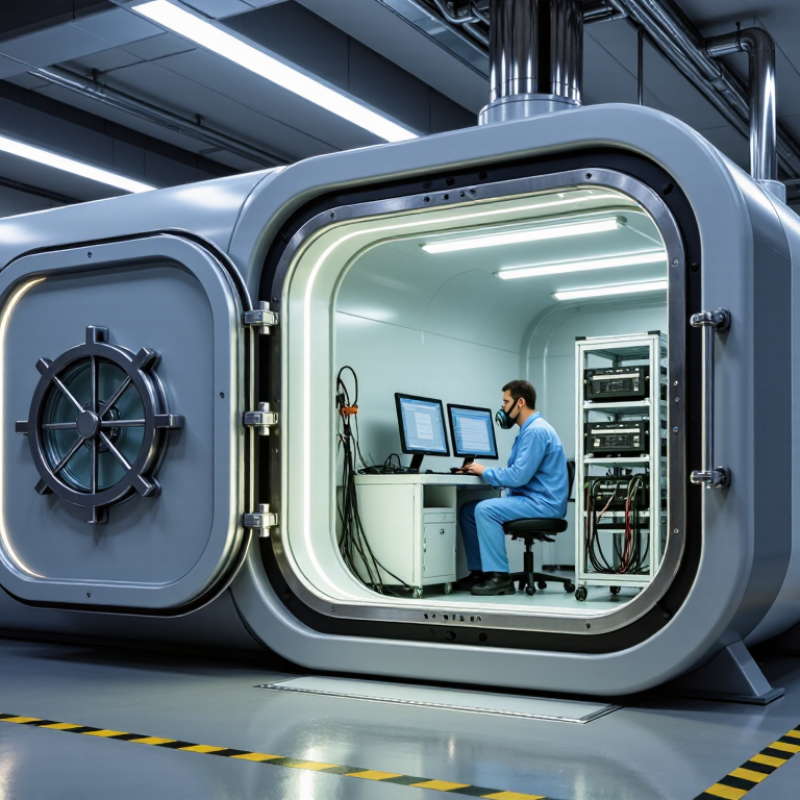
Define the Test Objective and Select Applicable Standards, Including MIL-STD-810H Method 500.6
Before comparing a barometric chamber for sale, define what the test must prove. Will the product operate at altitude, survive transport, or remain intact during storage? These are different objectives. Record the unit’s operating state, exposure duration, pressure profile, and any temperature conditions. For example, an electronic enclosure may need powered operation at reduced pressure, while a sealed package may need storage exposure. Note observable failure signs, such as resets, leakage, deformation, or measurement drift. A vague objective can produce polished data with little practical value.
Use MIL-STD-810H Method 500.6 when applicable, but do not treat it as a one-size-fits-all recipe. The method addresses low-pressure testing, with procedures selected for the intended exposure and life-cycle situation. Check the contract, product specification, and applicable procedure before setting altitude, dwell time, decompression rate, or test sequence. A suitable chamber should reach the required pressure consistently, control pressure changes at the needed rate, and fit the complete test setup. Leave space for cables, fixtures, sensors, and airflow around the specimen. Ask for calibration records and pressure-uniformity data. Even then, fixtures can distort readings. That deserves a check. Tailor acceptance limits to real use, and document any deviation.

Match Chamber Pressure Range to Test Altitude, Such as 18.8 kPa at 12,192 m
How to Choose the Best Barometric Chamber for Sale?
For a simulated altitude of 12,192 m, the target pressure is approximately 18.8 kPa absolute under the standard atmosphere. Confirm whether your test specification uses absolute or gauge pressure; confusing them can invalidate a test.
That distinction matters. Select a chamber whose controllable range includes the target, with room for pressure ramps and expected measurement tolerances. A unit that can only reach 18.8 kPa at its limit may struggle to hold that value steadily.
Check the chamber’s pressure sensor accuracy and stability across the range, not just its lowest advertised pressure. Ask for calibration details and test data near 18.8 kPa.
Then consider the actual setup: a large test article, cable feedthroughs, or repeated door openings can affect pressure recovery and test time. Check the whole setup. The controller should allow a controlled descent to the target and a stable dwell, while independent monitoring can help verify readings during qualification.
It is easy to focus on the altitude number and overlook temperature, humidity, or ramp rate. Those conditions may need separate controls, depending on the test plan. I would also allow time to confirm performance with the intended load; an empty chamber result may not represent the real test.
Size the Chamber for the Test Load and Required Air-Pressure Change Rate
Choosing the best barometric chamber starts with the test load, not the catalogue’s largest volume. Measure the product, fixtures, and cable bends, then allow clearance for installation and airflow. A packed chamber may reach the target pressure slowly or unevenly. Fit matters.
Next, define the pressure range and required change rate. The U.S. Standard Atmosphere, 1976 reports pressure near 101.3 kPa at sea level and about 26.5 kPa at 10 km altitude. These figures help frame the pressure span, but your test profile must set the actual ramp. Estimate evacuation time by dividing the pressure change by the required rate, then confirm that the chamber can maintain it with the real load installed. Pump performance can differ under load; I would not rely on an empty-chamber specification alone.
Tips: Ask for loaded-chamber ramp data across your operating range. Check usable internal dimensions, feedthrough space, and recovery time between cycles. Leave some margin. It is easy to underestimate the fixture.
How to Choose the Best Barometric Chamber for Sale?
Size the chamber for the test load and required air-pressure change rate. The chart shows the approximate standard airflow needed to change pressure at different rates for selected chamber free volumes.
Approximate airflow is calculated as chamber free volume × pressure-change rate ÷ 101.3 kPa, assuming conditions near atmospheric pressure and an isothermal process. Include the test load’s displaced volume when determining usable chamber volume; actual system requirements depend on temperature, leakage, plumbing, and control strategy.
Compare Pump Capacity, Pressure Stability, and Measurement Accuracy
When evaluating a barometric chamber for sale, match pump capacity to chamber volume and the required pressure-change rate. A large pump may shorten evacuation time, but it can also cause overshoot if the control system responds slowly. Ask for a pressure-versus-time test using a representative load, not an empty chamber. Check the pump’s rated flow at the actual operating pressure; free-air flow alone can mislead. Small detail, big impact.
Pressure stability and measurement accuracy matter just as much. WMO’s Guide to Instruments and Methods of Observation (WMO-No. 8) gives 0.1 hPa as a target uncertainty for surface-pressure measurements. Use that as a reference point, then compare it with the chamber’s stated accuracy, sensor range, and calibration conditions. Request stability data over a defined period and pressure range, plus calibration records traceable to recognized standards. A polished specification sheet is not proof. Seals, tubing, temperature, and sensor placement can all shift readings, and the real test may expose uneven performance. That deserves a second look.
Verify Safety Features, Calibration Traceability, and Service Support Before Purchase
How to Choose the Best Barometric Chamber for Sale?
A barometric chamber should be judged by its safety systems, not just its pressure range. Ask for the maximum operating pressure and the chamber’s rated limits in writing. Look for a pressure-relief device, door interlocks, and alarms that activate when readings exceed set limits. An emergency stop should be easy to reach. Small details matter. Check seals and viewing windows for clear inspection and secure closure. A polished control panel is useful, but it cannot replace documented safeguards.
Calibration records should identify the pressure sensors, calibration date, results, and measurement uncertainty. Verify that the calibration is traceable to recognized national or international standards, and ask for the supporting certificate. A certificate alone is not enough if it does not match the installed sensor. Ask how often recalibration is recommended and whether the chamber can be calibrated on site. Specifications can look excellent on paper; I would still check what the records actually cover.
Service support affects reliable operation over time. Before ordering, confirm who handles installation, operator training, repairs, and replacement parts. Ask how quickly technical staff typically respond and whether routine maintenance instructions are provided. A chamber may arrive ready to run, but pressure sensors and door seals still need attention. Do not assume support is included; get the scope and expected response times in writing.
How to Choose the Best Barometric Chamber for Sale? — Verify Safety Features, Calibration Traceability, and Service Support Before Purchase
Use this checklist to compare barometric chambers that simulate reduced or controlled absolute pressure. Confirm that each requirement matches your test method, applicable regulations, and operating environment.
| Evaluation Area | What to Verify | Useful Evidence to Request | Buyer’s Acceptance Check |
|---|---|---|---|
| Pressure range and measurement | Confirm the minimum and maximum absolute pressure, control range, display units, and measurement accuracy across the range you will use. | Technical specification showing the pressure range, accuracy or uncertainty, sensor type, and stated operating conditions. | Check that the usable range covers every required test point, including any margin needed by your procedure. |
| Pressure stability and control | Review pressure stability, set-point control, ramp-rate capability, and any documented overshoot or settling behavior. | Test data or a documented performance specification stating the conditions and method used for the results. | Compare performance with your test method’s allowable tolerances; do not assume a single stability figure applies at all pressures. |
| Safety design | Check the chamber’s pressure-rated construction, door or lid restraint, interlocks, alarms, and protective measures for abnormal conditions. | Risk assessment, operating manual, safety instructions, and documentation identifying the rated operating limits and protective devices. | Verify that safe operation and access procedures are clear, and that the chamber cannot be operated beyond its documented limits under normal use. |
| Overpressure and emergency response | Establish how the system responds to pressure exceeding a set limit, loss of power, control faults, or an emergency stop. | Functional descriptions, alarm and interlock test procedures, and maintenance instructions for safety-related components. | Confirm that protective actions are documented and can be tested during commissioning. Follow the manufacturer’s specified limits and procedures. |
| Calibration traceability | Determine whether pressure sensors and reference instruments are calibrated with results traceable to recognized national or international measurement standards. | Calibration certificate identifying the instrument, calibration date, results, uncertainty, and traceability information. If required, request a certificate from a laboratory accredited to ISO/IEC 17025 for the relevant measurement and range. | Check that the calibrated range and uncertainty suit your measurement needs. Accreditation may be a contractual or regulatory requirement; traceability and accreditation are not the same thing. |
| Calibration intervals and records | Ask how calibration intervals are established and how calibration history, adjustments, and out-of-tolerance findings are recorded. | Recommended interval, calibration procedure, sample record format, and guidance for handling results outside tolerance. | Set an interval based on instrument stability, use, risk, and your quality system rather than relying on an unsupported universal interval. |
| Chamber volume and test load | Check usable internal dimensions, access opening, fixture clearance, and any effect of the test load on pressure response or temperature conditions. | Dimensional drawing, loading guidance, and performance information for representative test loads where available. | Confirm that the largest planned item and its fixtures fit without obstructing the door, seals, sensors, or required airflow. |
| Temperature and environmental conditions | Clarify whether temperature control is included, what temperature range is available, and how pressure and temperature performance are specified together. | Separate pressure and temperature specifications, operating-environment limits, and information about any combined test conditions. | Do not treat a pressure-only chamber as a temperature-controlled system unless the required temperature capability is specified and verified. |
| Installation and commissioning | Review facility requirements, utilities, ventilation, placement, operator training, and acceptance testing before delivery. | Installation checklist, utility requirements, commissioning procedure, and a list of deliverables provided at handover. | Confirm that your site can meet the stated requirements and that commissioning includes checks relevant to your intended use. |
| Service and parts support | Ask how service requests are handled, what support is available remotely or on site, and how replacement parts and repairs are managed. | Written service terms, response-time commitments if offered, warranty conditions, parts-availability information, and escalation process. | Compare support commitments with your uptime needs, location, staffing, and ability to maintain the equipment internally. |
| Documentation and operator training | Ensure operators will receive clear instructions for setup, routine checks, safe operation, cleaning, and maintenance. | Sample operating and maintenance manuals, training outline, troubleshooting guidance, and recommended inspection records. | Verify that the documentation covers your configuration and is understandable to the personnel responsible for operation and upkeep. |
| Final purchase decision | Evaluate technical fit, safety documentation, calibration evidence, installation needs, and lifecycle support together. | Completed specification review, written clarifications, quotation, warranty terms, and agreed acceptance criteria. | Proceed only when key requirements are documented and any exceptions are resolved before purchase. |
Selection note: There is no single pressure range, calibration interval, or service response time that is right for every application. Define your test requirements first, then compare documented performance and support against those requirements.
Article Source:

Whether your solution requires a single pumping application or an expansive engineered system,
CheckPoint is committed to becoming your partner in excellence.


