China Top 10 Outdoor LED Display Manufacturers?
China’s outdoor LED display industry spans stadium screens, roadside billboards, retail facades, and weather-exposed public installations. Choosing a reliable outdoor LED display manufacturer requires more than comparing pixel pitch or factory photos. Buyers should examine cabinet sealing, brightness control, heat management, spare-parts support, and documented testing. A display facing strong sunlight needs stable visibility. Coastal projects need stronger protection against salt and humidity. These details often determine five-year operating costs.
This guide introduces ten notable Chinese manufacturers and explains which strengths may suit different projects. The review considers product engineering, production experience, certifications, customization, installation support, and long-term service. It also recognizes an important limitation: rankings can change as product lines, export teams, and service networks develop. No single supplier fits every site. A proven rental-screen company may not suit a permanent highway structure. Likewise, a low initial quotation can hide maintenance delays or limited module availability. Look closely.
Practical evaluation matters. Ask for recent project references, brightness measurements, IP ratings, refresh-rate data, warranty terms, and delivery schedules. Request sample cabinets when color consistency is critical. Inspect cable routing and module replacement procedures before signing. Independent verification remains valuable, even when a supplier presents impressive test reports. The strongest choice balances visible performance, engineering discipline, transparent communication, and dependable after-sales support. A careful comparison may take longer. That is acceptable. Mistakes outdoors are expensive.
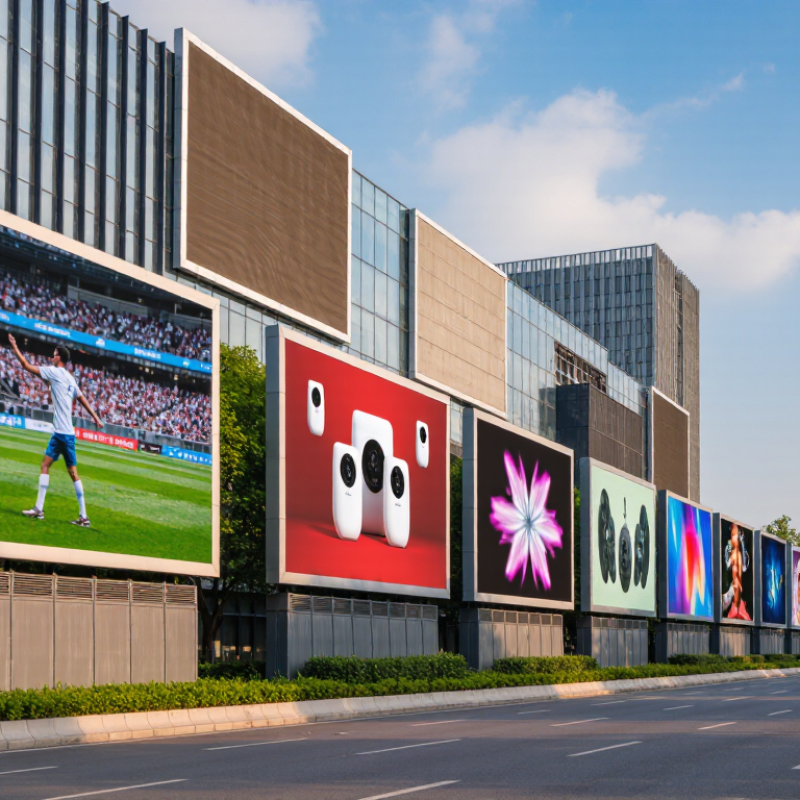
What Defines a Leading Outdoor LED Display Manufacturer?
What defines a leading outdoor LED display manufacturer is not only a bright cabinet or a competitive quotation. It is proven performance under sunlight, rain, heat, and dust. MarketsandMarkets projects the global LED display market to reach about US$11.1 billion by 2028, showing stronger demand for reliable visual systems. Manufacturers should therefore provide measured brightness, refresh rate, color consistency, and power consumption. A serious supplier also documents testing against IEC 60529, including suitable IP protection for outdoor cabinets.
Field experience reveals the difference. A display may look perfect indoors, yet lose color balance after months of ultraviolet exposure. Thermal design matters too. Front-service modules, sealed connectors, drainage channels, and replaceable power supplies can reduce maintenance time. Clear warranty terms and local technical support also indicate professional maturity. However, no factory is flawless. Even excellent samples can hide installation weaknesses, and published specifications may not reflect real operating conditions.
Tips: Request a running outdoor sample, not only photographs. Ask for brightness measurements at several angles and temperatures. Review independent test reports, spare-parts availability, and a maintenance plan. The TÜV Rheinland reliability guidance for LED products emphasizes environmental testing, while ISO 9001 certification can support process consistency. Still, certification alone proves little without traceable records, responsive engineers, and references from comparable outdoor projects.
What Defines a Leading Outdoor LED Display Manufacturer?
Outdoor LED manufacturers are commonly evaluated by weather protection, visibility, reliability, service life, and operating performance. The chart presents widely used industry reference benchmarks rather than company-specific data.
Reference points include IP65 environmental protection, approximately 5,000 nits or higher for daylight visibility, 3,840 Hz refresh performance for camera-friendly content, up to 100,000 hours of rated LED lifetime, and an operating range of about −20°C to +60°C. Actual specifications vary by application, climate, cabinet design, and installation conditions.
Technical references: IEC 60529 ingress protection classification and commonly used professional outdoor LED display procurement benchmarks.
Product Technologies and Applications in Outdoor LED Displays
China Top 10 Outdoor LED Display Manufacturers: Product Technologies and Applications
A credible China top-ten shortlist should begin with engineering, not advertising. MarketsandMarkets estimates the global LED display market will grow from about USD 7.3 billion in 2023 to USD 10.8 billion by 2028. Outdoor demand is supported by stadiums, transport hubs, retail streets, and public information systems.
Modern outdoor displays commonly use SMD LEDs, while fine-pitch COB designs improve protection and viewing quality. Pixel pitch determines readability. A 4-millimeter pitch suits roadside advertising, while 10-millimeter pitch can serve large stadium façades. High-brightness diodes must also manage glare. Poor calibration creates washed-out skin tones under direct sunlight. It happens.
IP65-rated cabinets help resist rain and dust, but sealing alone is not enough. Thermal design matters. Aluminum cabinets, ventilation paths, and temperature monitoring reduce brightness decay. The U.S. Department of Energy reports that LED technology can use at least 75% less energy than incandescent lighting, although display efficiency varies with brightness, content, and operating hours.
Applications increasingly require front maintenance, remote diagnostics, and automatic brightness control. A 2024 Grand View Research analysis identifies digital signage as a strong growth area, driven by networked content and commercial communication. Buyers should test grayscale performance, refresh rates, viewing distance, wind resistance, and spare-part availability. Laboratory figures can impress; installation records reveal more. Even experienced buyers may overlook maintenance access, which later becomes expensive.
How to Select the Right Chinese Outdoor LED Display Manufacturer
Choosing among China’s top outdoor LED display manufacturers requires more than comparing factory prices. MarketsandMarkets’ 2023 report valued the global LED display market at about USD 7 billion and projected nearly USD 12 billion by 2028. Grand View Research also forecasts strong growth through 2030. Estimates vary because the reports use different product definitions. Treat forecasts as direction, not proof.
Check outdoor performance before negotiating. Ask for measured brightness, refresh rate, cabinet weight, and power consumption. An IP65 rating should cover dust and water exposure from multiple directions. Request test records, not promises. Review thermal design, drainage, corrosion protection, and module replacement time. A bright screen is useless if heat causes frequent failures.
Experience matters here. Request installations operating for at least twelve months in climates resembling your site. Inspect photos taken at night, during rain, and under direct sunlight. Audit production controls, aging tests, calibration procedures, and spare-part availability. Verify relevant electrical and electromagnetic certifications for the destination market. A two-year warranty sounds attractive, but response time and local service matter more. I would not trust a glossy factory tour alone. Ask for a live video inspection and an itemized total-cost quotation. The cheapest offer may hide fragile power supplies, inconsistent color, or expensive shipping. That is an uncomfortable possibility, but it deserves attention.
China Top 10 Outdoor LED Display Manufacturers? - How to Select the Right Chinese Outdoor LED Display Manufacturer
Independent comparison framework based on commonly published outdoor LED display specifications and procurement criteria. All technical figures should be verified through current quotations, test reports, and project references.
| Rank | Anonymous Manufacturer Profile | Typical Outdoor Product Focus | Common Pixel Pitch | Typical Brightness | Refresh Rate | Ingress Protection | Typical Warranty | Estimated Production Lead Time | Recommended Verification Priority |
| 1 | Profile A — Large-scale export manufacturer | Fixed advertising and stadium displays | P4–P10 | 5,000–7,000 nits | 3,840–7,680 Hz | IP65 front / IP54 rear | 3–5 years | 25–45 days | Factory test reports and international references |
| 2 | Profile B — High-volume commercial display supplier | Shopping centers and roadside billboards | P5–P10 | 5,500–7,500 nits | 3,840–7,680 Hz | IP65 front / IP54 rear | 2–5 years | 20–40 days | Module consistency and spare-parts policy |
| 3 | Profile C — Rental and touring display specialist | Events, concerts, and temporary installations | P2.6–P4.8 | 4,500–5,500 nits | 3,840–7,680 Hz | IP65 front / IP54 rear | 2–3 years | 15–30 days | Cabinet strength, quick locks, and serviceability |
| 4 | Profile D — Fine-pitch outdoor engineering supplier | Corporate campuses and premium retail | P2.5–P4 | 4,000–6,000 nits | 3,840–7,680 Hz | IP65 front / IP54 rear | 3–5 years | 30–50 days | Actual viewing distance and thermal design |
| 5 | Profile E — Energy-efficient outdoor display supplier | Municipal, transport, and public-information screens | P5–P10 | 4,500–6,500 nits | 1,920–3,840 Hz | IP65 front / IP54 rear | 3–5 years | 25–45 days | Power consumption, heat dissipation, and compliance |
| 6 | Profile F — Customized architectural LED supplier | Media façades and irregular structures | P6–P20 | 3,500–6,000 nits | 1,920–3,840 Hz | IP65 front / IP54 rear | 2–5 years | 35–60 days | Structural drawings, wind-load calculations, and mock-ups |
| 7 | Profile G — Mid-market direct factory | Standard billboard and retail applications | P5–P10 | 5,000–7,000 nits | 1,920–3,840 Hz | IP65 front / IP54 rear | 2–3 years | 20–35 days | Factory identity, quality control, and after-sales capacity |
| 8 | Profile H — Integrated signage and control-system supplier | Digital signage networks and remote-managed screens | P4–P10 | 4,500–6,500 nits | 1,920–3,840 Hz | IP65 front / IP54 rear | 2–5 years | 25–45 days | CMS compatibility, network security, and remote monitoring |
| 9 | Profile I — Project-based engineering integrator | Large infrastructure and government projects | P5–P16 | 4,000–7,000 nits | 1,920–3,840 Hz | IP65 front / IP54 rear | 3–5 years | 40–75 days | Site survey, installation scope, and commissioning plan |
| 10 | Profile J — Small-batch customization supplier | Small commercial projects and special formats | P3.9–P10 | 4,000–6,000 nits | 1,920–3,840 Hz | IP65 front / IP54 rear | 2–3 years | 15–35 days | Sample approval, consistency between batches, and replacement parts |
Selection Checklist: Confirm LED package and driver specifications, brightness measured after calibration, actual IP test results, maximum power consumption, cabinet wind-load rating, operating temperature range, EMC and safety compliance, spare-parts availability, installation support, payment terms, and written warranty conditions before placing an order.