



China Top 10 Machine Safety Door Manufacturers

China’s factory floors are changing quickly. The International Federation of Robotics reported 541,302 industrial robot installations worldwide in 2023. China accounted for 276,288 of them, more than any other country. These figures come from IFR’s World Robotics 2024 report. More automated cells mean more moving equipment, access points, and potential pinch hazards.

A machine safety door helps separate people from hazardous machine motion while allowing controlled access for setup, cleaning, or maintenance. Its value depends on more than the door panel. Buyers must consider interlocking devices, guard construction, access frequency, and integration with the machine’s safety controls. ISO 14119 and ISO 13849-1 provide relevant guidance on interlocking devices and safety-related control systems. Fit matters. A poorly matched door can slow work or invite unsafe workarounds.

This guide introduces China’s top 10 machine safety door manufacturers and the factors that can help buyers compare them. Look for clear product specifications, application experience, customization capability, and responsive technical support. Ask how a supplier addresses door alignment, switch selection, and repeated opening cycles. Small details count. The IFR figures describe robot adoption, not demand for safety doors, so they should not be treated as a market-size estimate. Rankings also cannot reflect every factory’s needs. That is a limitation worth keeping in view.
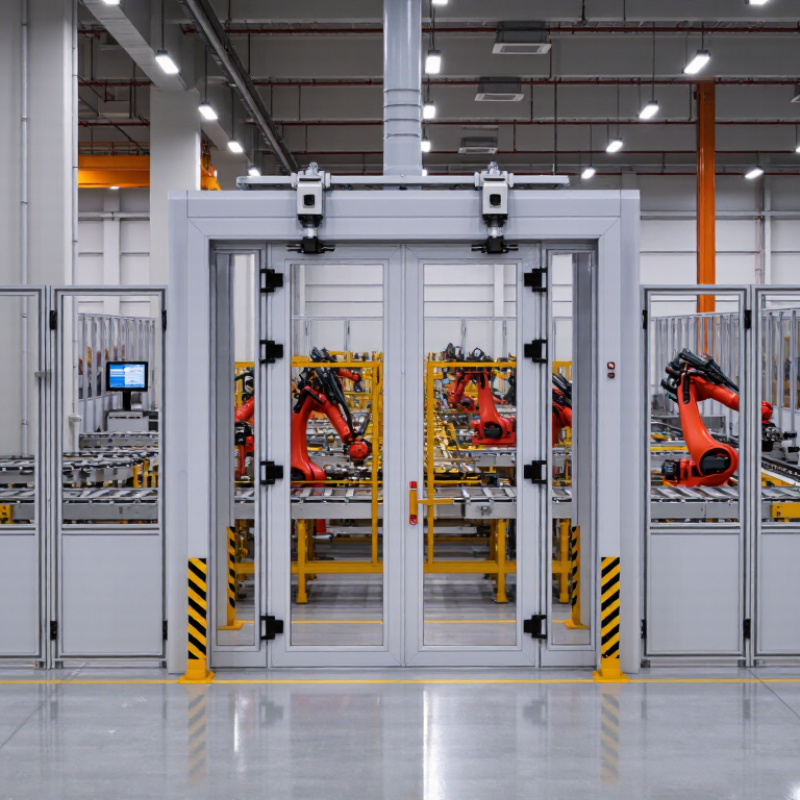
China Top 10 Machine Safety Door Manufacturers

Machine Safety Doors in China: Types, Applications, and Key Market Indicators

Machine safety doors in China range from hinged and sliding guards to lift-up doors and interlocked access panels. Hinged doors suit compact robot cells; sliding designs save space beside conveyors. Press lines and packaging equipment often need wider openings for tool changes and cleaning.

Details matter. Designers should match the guard to access frequency, machine stopping time, and the hazards identified in a site risk assessment.

ISO 14119 addresses interlocking devices, while ISO 14120 covers fixed and movable guards. A door that looks sturdy may still allow access before hazardous motion stops.

Demand is closely linked to automation growth. The International Federation of Robotics’ World Robotics 2024 report recorded 276,288 industrial robot installations in China in 2023, about 51% of global installations that year. This figure signals extensive use of guarded production cells, though it does not measure safety-door sales.

Useful purchasing indicators include opening cycles, interlock status, stop-time verification, resistance to impact, and ease of maintenance.

For example, a frequently opened door on a packing line may need a different design from a rarely accessed cell enclosure. Numbers help. Yet cycle life and stop-time data should be checked against actual operating conditions, not assumed from a catalogue.

ISO 14119:2013: Interlocking Devices, Coding Levels, and Guard Design

China Top 10 Machine Safety Door Manufacturers

ISO 14119:2013: Interlocking Devices, Coding Levels, and Guard Design

ISO 14119:2013 guides the selection and design of interlocking devices used with machine guards. The key question is practical: can the machine reach a hazardous state while someone can access it? A door switch should match the risk, not merely fit the frame. Where dangerous motion continues after a door opens, guard locking may be needed until the hazard has stopped. The risk assessment and machine design determine the appropriate arrangement.

Coding levels describe how specifically an actuator is paired with its interlocking device. Low-coded devices may be easier to defeat with a similar actuator; higher coding can make substitution harder. Coding is not a substitute for sound guard design. Position the switch to reduce impact, tampering, and accidental misalignment. Check that the door cannot be opened far enough to reach a hazard before the interlock responds. Small details matter. In real installations, a flexible hinge or a few millimeters of sag can change alignment. Drawings do not always reveal that.

For manufacturers and machine builders, verification should include installation, operation, and foreseeable misuse. Test the door under realistic conditions, including vibration and repeated opening. Confirm that reset actions do not restart hazardous motion unexpectedly. Record the device type, coding level, and rationale for the chosen guard arrangement. One point deserves reflection: adding a more complex switch may look like better protection, yet poor placement can still leave a weak system.

ISO 13849-1:2023: Performance Levels PL a–e for Safety-Related Controls

ISO 13849-1:2023 defines Performance Levels (PL a to PL e) for safety-related control systems. PL a represents the lowest risk-reduction capability; PL e represents the highest. Their dangerous-failure probability ranges from 10⁻⁵–<10⁻⁴ per hour for PL a to 10⁻⁸–<10⁻⁷ for PL e. The required level, PLr, comes from risk assessment—not a door’s product label.

Not a label.

For a machine safety door, assess the complete chain: interlock, control logic, wiring, and stopping devices. A correctly selected switch cannot compensate for weak diagnostics or poor installation. Check architecture, component reliability, diagnostic coverage, and common-cause failures, then validate the design under realistic operating conditions. A door opening should trigger the intended safe response, and closing it should not cause an unexpected restart. Small details matter.

Eurostat reported about 3.3 million non-fatal workplace accidents and 3,347 fatal accidents across the EU in 2021. Those figures do not prove that a particular safeguard failed, but they underline why verified risk reduction matters.

When comparing machine safety door manufacturers, request evidence for the achieved PL and the full control-system configuration. A checklist can still miss wear, misalignment, or changing production cycles; review those assumptions during operation.

China’s Top 10 Machine Safety Door Manufacturers: Profiles and Product Ranges

China’s machine safety door sector includes manufacturers with distinct engineering strengths and product ranges. One profile focuses on full-height steel enclosures for machining cells, with hinged access panels and reinforced viewing windows. Another supplies sliding doors for compact workshops where aisle space is limited. A third builds modular aluminum guarding that can be resized as production lines change. Interlocked access doors form another category, often paired with sensors and control interfaces. Simple, but practical. Other suppliers specialize in washdown-ready stainless steel doors, sound-reducing panels, large-format openings, or custom guards for robotic work areas. Product names matter less than fit, finish, and repeatable alignment.


A useful profile compares frame materials, door travel, window options, locking methods, and available dimensions. It should also explain how replacement parts are sourced and how installation is supported. Some manufacturers offer standard panels that shorten procurement time; others make to-order assemblies for unusual machine layouts. Ask for drawings and test evidence, not only catalogue images. Details can be overlooked. A door that clears a robot arm on paper may still obstruct maintenance access in a real cell. The strongest supplier comparisons therefore connect product ranges with clear technical documentation, responsive engineering, and consistent quality checks. These points help buyers distinguish broad capability from a convincing brochure.

Comparing Manufacturers by Safety Compliance, Door Ratings, and Service Coverage

For a China-focused top-10 comparison, judge machine safety door manufacturers by documented compliance, verified performance, and support after installation. EU-OSHA’s ESENER 2019 survey found that 76% of establishments regularly carried out workplace risk assessments. That makes traceable risk-assessment documents useful when checking whether a door system fits a specific machine. Ask for evidence against ISO 14119 and ISO 13849-1, including the safety function’s achieved performance level. A brochure alone is not proof.

Compare door-locking ratings with the machine’s required performance level, not just the lock’s advertised rating. Check guard-locking principles, escape release, cycle endurance, and environmental protection such as IP rating. IP protection describes resistance to dust and water; it does not establish functional safety. Service coverage matters too: confirm commissioning support, spare-part availability, language options, and realistic response times for your plant location. Small detail, big impact. Published specifications can still leave gaps.

Tips: Request test reports and a sample risk-assessment document. Ask who supports the installation after delivery, and how quickly replacement parts can reach your site. Then compare like with like. Some supplier information may be incomplete, so record what remains unverified.

Whether your solution requires a single pumping application or an expansive engineered system,
CheckPoint is committed to becoming your partner in excellence.