


A busy Saturday market is a useful test for any mobile checkout: the line grows, a customer taps a card, and the seller needs a clear answer before the next person arrives. The best mobile pos systems make that moment feel simple. They combine payment acceptance with tools for tracking sales, checking stock, and keeping customer records. Yet a polished screen does not guarantee a good fit.
Square co-founder Jack Dorsey has described Square’s early goal as making card acceptance accessible to sellers. That idea still matters. A mobile POS should help a business take payments where work happens, whether that is beside a food truck window or at a customer’s table. The best mobile POS systems also need dependable hardware, transparent pricing, useful reporting, and support that responds when a device stops connecting. Small details count.
This guide compares leading options by cost, features, usability, and business needs. It considers independent retailers, restaurants, service providers, and sellers who travel between locations. No single system wins for everyone. A low monthly price may hide transaction costs; a powerful inventory tool may take more time to learn. Those trade-offs deserve a closer look. The comparison also has limits: pricing and features can change, and real-world performance depends on connectivity and setup. A little skepticism helps. A demo, a trial, or a careful review of current terms can reveal whether a system suits the way a business actually sells.
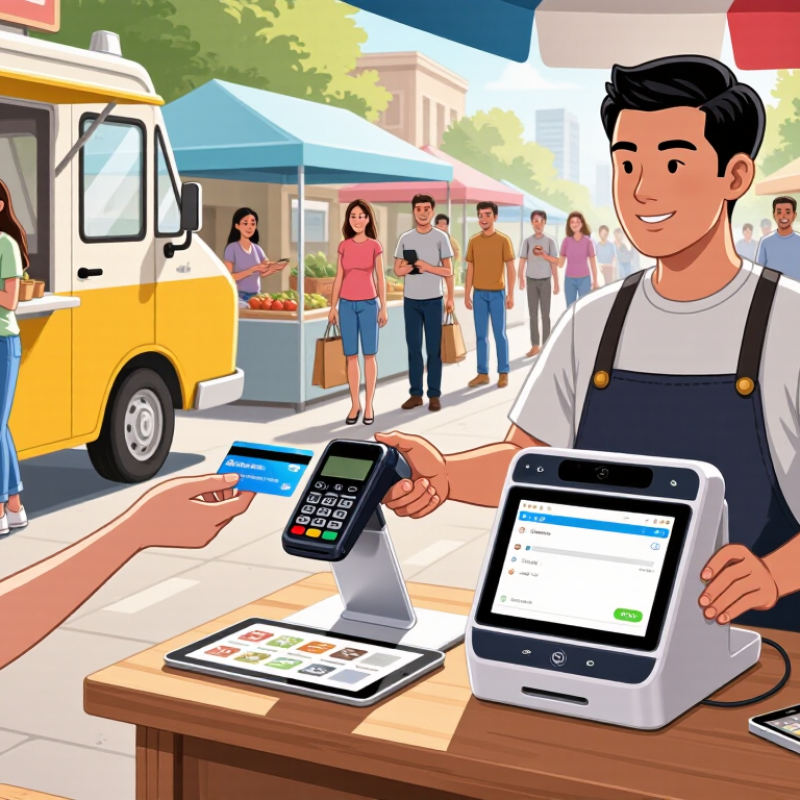
A mobile point-of-sale (POS) system lets staff take orders and payments using a phone or tablet, often with a compact card reader. Unlike a fixed checkout, it can move with the customer: beside a café table, at a market stall, or across a shop floor. The device runs software that records items, prices, discounts, and payment status. Short version: the checkout travels. Some setups need only a phone; others use a reader, receipt printer, or cash drawer. The right configuration depends on the business and its daily workflow.
When a customer is ready to pay, staff select the order, confirm the total, and offer available payment methods. The system sends the transaction securely for processing and records whether it succeeded. It may also update inventory, email a receipt, or add the sale to reports. That matters. Managers can review sales without manually matching every paper slip. A reliable connection helps, though some systems offer limited offline functions; their rules and fees can vary. Test the system where it will actually be used. A tablet can feel clumsy in a crowded aisle, and a weak signal may slow checkout. Those small inconveniences are easy to overlook during a tidy product demonstration.
| Mobile POS setup | Typical equipment | How a sale works | Key strengths | Things to check | Often suitable for |
|---|---|---|---|---|---|
| Phone-based POS | A smartphone, POS app, and compatible contactless reader; some phones can accept contactless payments directly where supported. | The seller adds items in the app, calculates the total, accepts a supported payment, and sends or prints a receipt. | Portable and quick to set up; useful when checkout space is limited. | Check device and payment-reader compatibility, battery life, network coverage, and transaction fees. | Solo sellers, service providers, pop-up shops, and small market stalls. |
| Tablet-based POS | A tablet, POS app, payment reader, and optionally a stand, receipt printer, cash drawer, or barcode scanner. | Staff select or scan products, review the basket, take payment through a connected reader, and record the sale in the POS software. | A larger screen can make product browsing, order entry, and staff workflows easier than on a phone. | Additional peripherals can increase setup cost and require compatible connections or charging. | Retail counters, food service, and businesses that need a more detailed product catalog. |
| Dedicated handheld POS terminal | A purpose-built handheld device with a touchscreen and integrated or paired payment hardware; some models include a barcode scanner or receipt printer. | The employee enters or scans the order on the terminal, presents the supported payment option, and completes the transaction on the device. | Combines order entry and payment in a portable unit and can be designed for frequent daily use. | Compare device durability, battery runtime, connectivity, repair options, and whether required features are included. | Restaurants taking orders at tables, delivery teams, and retailers serving customers across a floor. |
| Mobile POS with offline capability | A phone, tablet, or handheld POS configured with software that supports certain offline workflows. | Depending on the provider, the app may store order details or queue eligible payments while disconnected; data syncs or payments are submitted when connectivity returns. | Can help keep some sales workflows running during a temporary internet outage. | Offline payment acceptance is not universal. Queued card payments may be declined later, and feature limits, transaction caps, and risk are provider-specific. | Markets, events, mobile businesses, or locations where internet access may be unreliable. |
A mobile POS system combines POS software, a mobile device, and payment hardware or a supported contactless payment feature. It records items and totals, sends payment information through a payment processor for authorization, and updates the transaction record. Payment methods, offline features, hardware compatibility, and fees vary by provider and region.

Whether your solution requires a single pumping application or an expansive engineered system,
CheckPoint is committed to becoming your partner in excellence.