



2026 Top Types of High Mast Street Lights for Global Buyers

High Mast Street Light systems are becoming more important as cities expand highways, logistics parks, ports, airports, and wide public spaces. For global buyers, the best solution is rarely the brightest fixture. It must also control glare, resist wind, simplify maintenance, and match local electrical conditions.

The International Energy Agency’s Energy Efficiency 2024 report identifies efficient lighting as a continuing source of electricity savings. The U.S. Department of Energy’s Solid-State Lighting research also shows that advanced LED packages can achieve very high laboratory efficacy, although complete fixtures perform differently. This distinction matters. A 400-watt LED fixture may look efficient on paper, yet poor optics can waste light beyond the roadway. DOE guidance also stresses thermal management, controls, and system-level performance.

“Lighting is not just about seeing; it is about making sense of the visual environment,” wrote lighting researcher Peter R. Boyce in Human Factors in Lighting. His observation is highly relevant to High Mast Street Light selection. Uniform illumination matters more than raw lumen output. A driver needs clear lane edges, visible pedestrians, and fewer harsh contrasts.

This 2026 guide examines fixed LED, modular LED, solar hybrid, smart adaptive, and high-wind-rated designs. It considers mounting height, beam distribution, IP and IK protection, color temperature, maintenance access, and lifecycle cost. Some rankings remain debatable. A solar model may perform well in a sunny industrial zone but struggle during long cloudy seasons. That is the uncomfortable detail buyers should not ignore.
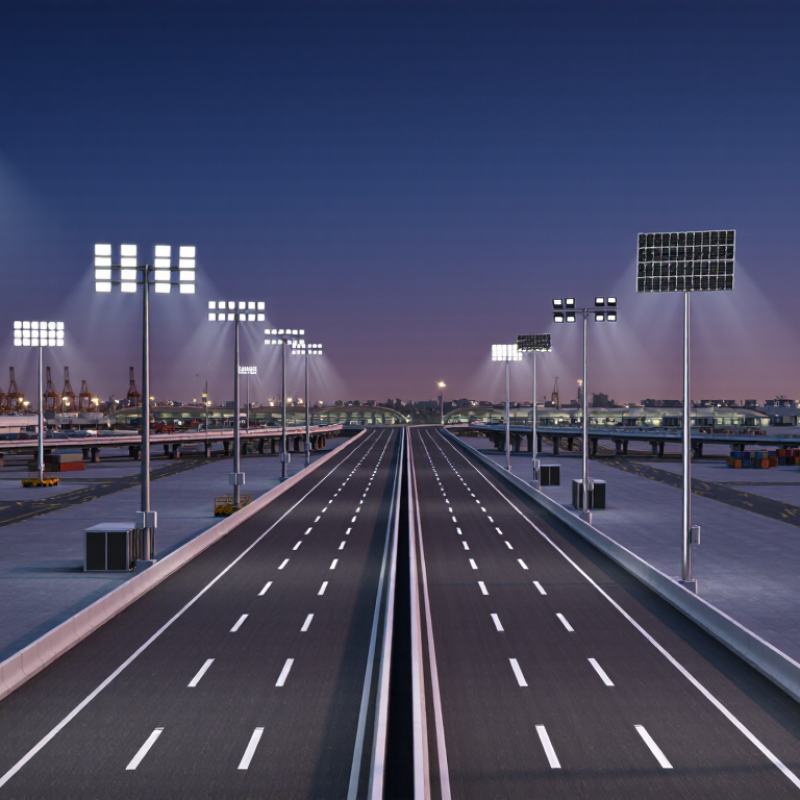
2026 Top Types of High Mast Street Lights for Global Buyers

High Mast Street Light Basics and Key Design Features

High mast street lights usually serve wide roads, ports, airports, and logistics yards. Their poles often rise 20–40 meters above ground. A typical head carries several luminaires, spreading light across large paved areas. The design starts with mounting height, road width, pole spacing, and target illuminance. Glare control matters as much as brightness. Excessive uplight wastes energy and disturbs nearby homes.

LED systems now dominate new installations because they offer precise optics, dimming, and longer service intervals. The International Energy Agency reports that lighting uses roughly 15% of global electricity demand. That figure makes optical efficiency important, not decorative. The U.S. Department of Energy’s Solid-State Lighting research reports have identified laboratory LED efficacies above 200 lumens per watt, while real outdoor systems perform lower after drivers, optics, temperature, and dirt losses. Buyers should check complete-fixture efficacy, not chip claims. Small detail. Big difference.

Tips: Request a photometric file, wind-load calculation, surge protection rating, and maintenance plan before ordering. Review lighting uniformity, not only average lux. IES recommendations can guide roadway criteria, but local conditions still require professional calculations. In coastal areas, corrosion-resistant hardware deserves attention. In dusty yards, sealed optics may reduce cleaning work. One imperfect assumption can distort the whole layout, so verify pole shadows with a site simulation.

2026 Top Types of High Mast Street Lights for Global Buyers - High Mast Street Light Basics and Key Design Features

High Mast Light Type Typical Mounting Height Light Source and Output Luminaire Arrangement Recommended Applications Key Design Features Maintenance Considerations
Fixed-Crown LED High Mast 20–45 m typical LED modules; commonly 100–400 W per luminaire, depending on optics and lighting targets Usually 4–12 luminaires mounted on a fixed crown Large interchanges, ports, airports, industrial yards, logistics centers, and open public areas Rigid crown, narrow or asymmetric optics, corrosion-protected steel pole, wind-load analysis, and surge protection Maintenance normally requires a truck-mounted platform, access equipment, or specialist lifting equipment
Raising-and-Lowering High Mast 15–40 m typical LED luminaires; wattage is selected according to mounting height, spacing, and required illuminance Movable lantern carriage with multiple floodlights or roadway luminaires Road junctions, container terminals, sports grounds, storage yards, and sites where routine maintenance access is important Internal winch, stainless-steel wire rope, locking mechanism, carriage guide, and manual or motorized lowering system Fixtures can be lowered to ground level; the winch, cable, brake, and locking parts require periodic inspection
Multi-Projector Floodlight Mast 18–35 m typical Separate LED floodlights, often 100–600 W each for wide-area coverage Individually aimed projectors on a ring, platform, or adjustable brackets Ports, construction compounds, rail yards, bulk-material terminals, and large industrial sites Flexible aiming angles, replaceable floodlight units, glare shields, and multiple beam distributions Individual luminaires can be serviced separately; aiming and photometric verification should be checked after replacement
Roadway-Optic High Mast 20–40 m typical LED roadway luminaires; output is commonly configured from approximately 20,000 to 60,000 lumens per luminaire Two or more luminaires using asymmetric Type II, III, or IV-style roadway distributions High-speed roads, interchanges, bridges, toll plazas, and long approach roads Controlled forward throw, reduced backlight, uniformity-focused photometry, dimming capability, and low-glare shielding Photometric performance should be checked using the actual road layout, pole spacing, mounting height, and maintenance factor
Solar LED High Mast 10–25 m typical for independent solar installations High-efficiency LED system powered by photovoltaic panels and rechargeable batteries; output depends on the solar design One or more LED luminaires on a fixed or lowering crown Remote roads, border facilities, rural junctions, disaster-response areas, and sites without reliable grid power Solar resource assessment, battery autonomy, charge controller, panel tilt, theft protection, and low-voltage DC design Battery replacement is a major lifecycle task; panels require cleaning and the system must be sized for seasonal solar conditions
Smart and Adaptive High Mast 15–40 m typical Dimmable LED luminaires with programmable drivers; power level varies with traffic and operating schedules Fixed or lowering crown with individually addressable luminaires Smart highways, airports, ports, logistics parks, municipal infrastructure, and energy-monitoring projects Astronomical timer, photocell, motion or traffic sensing, remote monitoring, fault alerts, and scheduled dimming Software commissioning and communications testing are required; local manual override is recommended for service work
Hybrid High Mast with Floodlight and Roadway Optics 20–45 m typical Mixed LED packages selected for both long-throw roadway lighting and broad-area floodlighting Combination of asymmetric roadway luminaires and adjustable floodlights Interchanges beside service areas, port access roads, airport aprons, and multi-use industrial zones Independent circuits, separate optical distributions, selective dimming, glare control, and flexible future upgrades Circuit labeling and aiming records are especially important because each luminaire may serve a different lighting zone
Buyer Design Notes: The dimensions and power ranges shown are typical planning values rather than universal requirements. Final selection should be based on a photometric calculation, wind and structural design, local electrical rules, glare limits, corrosion conditions, access requirements, and the applicable lighting standard. Outdoor LED high-mast luminaires are commonly specified with IP66 protection, surge protection, and an operating temperature range suitable for the project climate; these values must be confirmed in the product specification.

LED High Mast Lights for Energy-Efficient Roadway Illumination

LED high mast lights are reshaping roadway illumination in 2026. Their concentrated beams cover wide interchanges, ports, logistics yards, and major approaches. Common options include fixed-output, adaptive, and modular LED systems. Compared with older discharge systems, LEDs can deliver useful light with lower power demand. They also start instantly. That matters during storms, outages, and nighttime maintenance. A well-designed 30-meter mast can reduce pole clutter and simplify traffic-area planning. However, height alone does not guarantee efficiency.

Experienced lighting engineers begin with road geometry, traffic speed, mounting height, and pavement reflectance. Photometric simulations help place light where drivers need it, not into nearby homes or the sky. Quality LED modules should provide stable output, controlled glare, and suitable color rendering. For many roads, neutral white light improves sign visibility without creating harsh visual contrast. Adaptive dimming can lower output during quiet hours, while sensors respond to weather or traffic changes. Controls need reliable communication and manual override. Small details matter. A sealed housing, corrosion-resistant finish, and surge protection support long service in coastal or dusty environments.

Maintenance teams should inspect lenses, drivers, wiring, and foundations on a planned schedule. Remote monitoring can reveal rising temperatures or failed modules before dark sections become dangerous. Yet published energy savings may look better than field results. Dirty optics, poor aiming, and unrealistic operating schedules can weaken performance. I would not specify wattage from road width alone. Every project needs measured illuminance, uniformity checks, and local compliance review.

Solar-Powered High Mast Street Lights for Off-Grid Applications

Solar-powered high mast street lights are gaining attention among global buyers in 2026. For off-grid roads, ports, mining areas, and large public spaces, they reduce dependence on utility connections. These systems combine photovoltaic panels, LED floodlights, batteries, and intelligent controllers. Typical masts range from 12 to 30 meters high. Their elevated optics spread light across wide zones, reducing the number of poles required.

Several solar high mast types suit different applications. Integrated systems place the panel, battery, and luminaire on one structure. Split systems use separate battery cabinets, which can simplify maintenance in harsh climates. Fixed-angle panels work well where sunlight is consistent, while adjustable panels support seasonal optimization. Lithium batteries offer compact storage, but thermal protection remains essential. Oversized panels alone cannot solve poor winter performance.

Site assessment should come before product selection. Engineers need to examine solar radiation, wind load, soil conditions, dust, humidity, and required lighting levels. Battery autonomy should cover several cloudy nights, not only average weather. In field inspections, shading is often underestimated. A nearby tower or growing tree can reduce daily charging. The weak point may be installation, not the lamp. Buyers should request photometric files, corrosion protection details, battery cycle data, and controller safeguards. A design can look efficient on paper, yet perform poorly without correct tilt, drainage, and scheduled maintenance. Reflection matters. Lower output may be wiser than unreliable brightness.

Smart High Mast Lighting with Remote Monitoring and Control

Smart High Mast Lighting with Remote Monitoring and Control is reshaping large outdoor spaces. High mast poles, often 20 to 40 meters tall, illuminate ports, airports, highways, and logistics yards. Networked LED luminaires can adjust brightness by schedule, traffic flow, or detected activity. This reduces wasted light when an entire yard is quiet.

The International Energy Agency reports that lighting uses about 15% of global electricity. The U.S. Department of Energy also identifies LED conversions as a practical route to major street-lighting energy savings. Remote monitoring adds another layer. Operators can view power consumption, lamp status, temperature, and outage alarms from a central dashboard. Maintenance teams may then replace one failed module instead of inspecting every pole. That saves time, especially where lifting equipment is expensive.

Remote control is not magic. Poor sensor placement can trigger unnecessary dimming or brightening. Wireless links may weaken around steel structures and heavy equipment. Commissioning must include night testing, emergency overrides, surge protection, and cybersecurity reviews. The National Institute of Standards and Technology recommends risk-based security practices for connected systems, which also apply to smart lighting networks. In practical projects, operators should demand open communication protocols and exportable data. Future software updates matter, but basic reliability matters more. A perfectly connected system is still disappointing when the light distribution is uneven.

How Global Buyers Choose High Mast Street Lights for Different Sites

How Global Buyers Choose High Mast Street Lights for Different Sites

Global buyers should match high mast street lights to site conditions, not catalog appearance. Highways usually need narrow-beam LED luminaires with precise glare control. Ports and logistics yards often require wide-beam optics for container lanes and loading zones. Sports grounds need stronger vertical illumination and reduced spill light. Industrial sites may prioritize vibration resistance, corrosion protection, and easy maintenance access.

The U.S. Department of Energy reports that LED lighting can reduce energy use by more than 50% compared with conventional technologies. Its solid-state lighting research also shows continuing gains in efficacy and service life. These figures matter, but they cannot replace field testing. The International Energy Agency identifies lighting efficiency and smart controls as important energy-saving measures. Therefore, buyers should check dimming performance, surge protection, thermal management, and photometric files. A 30-meter mast beside a wet coastline needs different protection from one serving a dry inland road. Small details matter.

Tips: Ask suppliers for site-specific simulation files, not only lumen values. Compare maintained illuminance, uniformity, glare, wind loading, and cleaning access. Request test reports based on recognized standards, such as IEC or CIE guidance. A lower wattage is not always cheaper. Poor optics can create dark patches, complaints, and extra installation costs. In practice, buyers often underestimate maintenance distance and replacement logistics. That mistake deserves more attention.

2026 Top Types of High Mast Street Lights for Global Buyers

How global buyers choose high mast street lights for different sites

Typical LED system power ranges vary by mounting height, roadway classification, pole spacing, required illuminance, beam distribution and local standards. Fixed floodlight systems are commonly used for highways and industrial yards, ring-mounted multi-projector systems suit ports and large parking areas, and lowering systems are preferred where maintenance access is a major concern. The ranges shown are indicative planning values rather than final lighting designs.

Whether your solution requires a single pumping application or an expansive engineered system,
CheckPoint is committed to becoming your partner in excellence.